Author Description
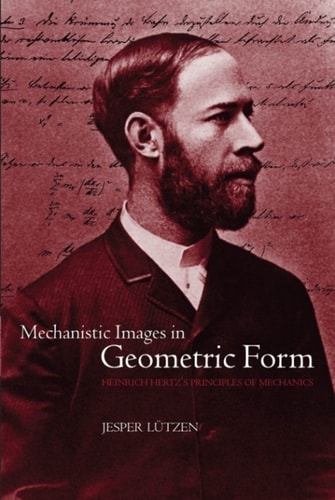
This book gives an analysis of Hertz's posthumously published Principles of Mechanics in its philosophical, physical and mathematical context. In a period of heated debates about the true foundation of physical sciences, Hertz's book was conceived and highly regarded as an original and rigorous foundation for a mechanistic research program. Insisting that a law-like account of nature would require hypothetical unobservables, Hertz viewed physical theories as (mental) images of the world rather than the true design behind the phenomena. This paved the way for the modern conception of a model. Rejecting the concept of force as a coherent basic notion of physics he built his mechanics on hidden masses (the ether) and rigid connections, and formulated it as a new differential geometric language. Recently many philosophers have studied Hertz's image theory and historians of physics have discussed his forceless mechanics. The present book shows how these aspects, as well as the hitherto overlooked mathematical aspects, form an integrated whole which is closely connected to the mechanistic world view of the time and which is a natural continuation of Hertz's earlier research on electromagnetism. Therefore it is also a case study of the strong interactions between philosophy, physics and mathematics. Moreover, the book presents an analysis of the genesis of many of the central elements of Hertz's mechanics based on his manuscripts and drafts. Hertz's research program was cut short by the advent of relativity theory but its image theory influenced many philosophers as well as some physicists and mathematicians and its geometric form had a lasting influence on advanced expositions of mechanics.
Menrva's Summary
THE THESIS
*This book investigates the philosophical, physical, and mathematical foundations of Heinrich Hertz's posthumously published Principles of Mechanics to determine its role in the evolution of the mechanistic research program.* Jesper Lützen, a historian of science, utilizes Hertz's original manuscripts and drafts to reconstruct the genesis of his ideas. The author argues that Hertz's rejection of force as a fundamental concept in favor of hidden masses and rigid connections represents a critical shift toward modern modeling. By integrating Hertz's image theory with his differential geometric approach, Lützen demonstrates how these elements formed a cohesive, albeit short-lived, alternative to classical Newtonian mechanics.
THE SCOPE MAP
What You Will Find
- Analysis of Hertz's image theory and its influence on modern scientific modeling.
- Examination of the mathematical structure of Hertz's forceless mechanics.
- Historical context regarding the transition from classical mechanics to relativity.
- Comparative study of Hertz's earlier work on electromagnetism and his later mechanical principles.
Scope Limits
- The text does not provide a general biography of Heinrich Hertz beyond his scientific and philosophical contributions.
- It does not cover the full breadth of 19th-century physics, focusing specifically on the mechanistic research program.
THE AUTHORITY PERSPECTIVE
Scholars and historians of physics recognize this work as a rigorous examination of the intersection between philosophy and mathematical physics. Readers frequently note the academic density of the prose, which is best suited for those with a background in the history of science or theoretical physics.
Page Count:
332
Publication Date:
2005-01-01
Publisher:
Oxford University Press
ISBN-10:
0191524344
ISBN-13:
9780191524349
Earth Sciences
Physics
Science History
Mathematics
Mechanics
Geometry
Philosophy of
Community Tags
Similar Books