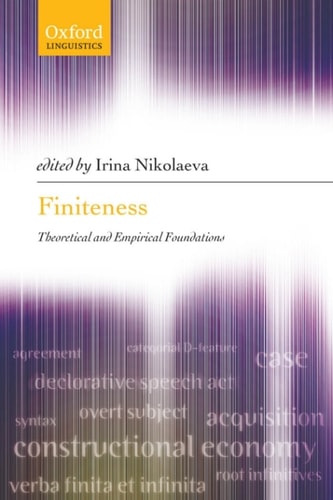
Finiteness: Theoretical and Empirical Foundations
0
0
As an Amazon Associate and affiliate partner, Menrva Books earns from qualifying purchases. Learn more
Author Description
This book explores the nature of finiteness, one of most commonly used notions in descriptive and theoretical linguistics but possibly one of the least understood. Scholars representing a variety of theoretical positions seek to clarify what it is and to establish its usefulness and limitations. In doing so they reveal cross-linguistically valid correlations between subject licensing, subject agreement, tense, syntactic opacity, and independent clausehood; show how these properties are associated with finiteness; and discuss what this means for the content of the category. The issues explored include how different grammatical theories represent finiteness; whether the finite/nonfinite distinction is universal; whether there are degrees of finiteness; whether the syntactic notion of finiteness has a semantic corollary; whether and how finiteness is subject to change; and how finiteness features in language acquisition. Irina Nikolaeva opens the book by describing the history of finiteness and its place in current thinking and research. She then introduces the chapters of the book, comparing the authors' perspectives and showing what they have in common. The book is then divided into four parts. Part I considers the role finiteness plays in formal syntactic theories and Part II its deployment in functional theories and as the subject of research in typology. Parts III and IV look respectively at the finite/nonfinite opposition in individual languages and at the role finiteness plays in linguistic change and linguistic development. The book is written and structured to appeal to scholars and students of syntax and general linguistics at graduate level and above.
Menrva's Summary
THE THESIS
This volume investigates the theoretical and empirical foundations of finiteness, a central yet contested concept in linguistic analysis. Irina Nikolaeva, a specialist in syntax and typology, compiles research from diverse theoretical frameworks to evaluate the utility and limitations of the finite/nonfinite distinction. The text synthesizes findings across formal and functional linguistics to determine whether finiteness functions as a universal category or a gradient phenomenon.
THE SCOPE MAP
What You Will Find
- Comparative analysis of formal syntactic and functional linguistic theories regarding finiteness.
- Cross-linguistic data examining subject licensing, agreement, and syntactic opacity.
- Discussions on the diachronic evolution of finiteness and its role in language acquisition.
Scope Limits
- The text does not provide a singular, unified definition of finiteness, as it focuses on the debate between competing theoretical perspectives.
- The analysis is restricted to graduate-level linguistic discourse and assumes prior knowledge of syntactic theory.
THE AUTHORITY PERSPECTIVE
Scholars and graduate students identify this work as a comprehensive reference for understanding the complexities of the finite/nonfinite distinction in modern linguistics. Experts highlight the book's value in bridging the gap between formal syntactic models and functional typological research.
Page Count:
448
Publication Date:
2007-01-01
Publisher:
Oxford University Press
ISBN-10:
019152672X
ISBN-13:
9780191526725
English & College Success
Academic
English
Syntax
Grammar
Reference
Linguistics
Typology
Community Tags
Similar Books