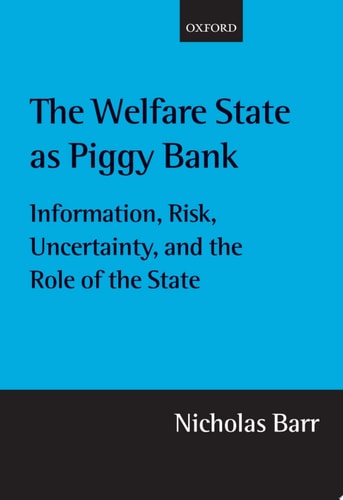
Welfare State as Piggy Bank: Information, Risk, Uncertainty, and the Role of the State
0
0
As an Amazon Associate and affiliate partner, Menrva Books earns from qualifying purchases. Learn more
Author Description
Of The Many Functions Of The Welfare State, Two Are Particularly Prominent: The 'robin Hood' Function - The Provision Of Poverty Relief, The Redistribution Of Income And Wealth, And The Reduction Of Social Exclusion; And The 'piggy Bank' Function - Ensuring Mechanisms For Insurance And For Redistribution Over The Life Cycle. The Piggy-bank Function, Unlike The Redistributive Purpose Of The Welfare State, Has Received Relatively Little Attention, And Is Not Widely Understood. This Book Redresses The Balance. Nicholas Barr's Central Contention Is That—-contrary To Popular Opinion—-the Welfare State Exists For Reasons Additional To Poverty Relief. These Reasons - Encapsulated By The Piggy-bank Function - Arise Out Of Pervasive Problems Of Imperfect Information, Risk, And Uncertainty. Even If All Poverty And Social Exclusion Could Be Eradicated, People Would Still Need To Insure Themselves And To Redistribute Over The Life Cycle. As A Result, Barr Argues, The Welfare State Is Here To Stay, Since Twenty-first Century Developments Do Nothing To Undermine These Reasons. He Also Explores Ways In Which The Welfare State Can And Will Adapt To Economic And Social Change, Including Specific, And Sometimes Novel, Solutions. The Analysis In The Welfare State As Piggy Bank Is International, Applying To Advanced Industrial Countries, As Well As Addressing Post-communist Countries, And Touching Upon Middle-income Developing Countries. Barr's Approach Is Contemporary And Forward-thinking. His Discussion Ranges Over A Number Of Topics Of Central Relevance To Life In The Twenty-first Century, Including Genetic Screening And Its Impact On Insurance; The Convergence Of Private And Social Insurance; How To Finance Long-term Care; Pension Reform In The Light Of Fluid Family Structures And A Mobile Workforce; Loans For Financing Investment In Human Capital; And New Ways Of Involving Private Finance In Tertiary Education.
Menrva's Summary
THE THESIS
The book investigates the core question of why the welfare state remains necessary beyond its role in poverty relief, specifically focusing on its function as a mechanism for insurance and life-cycle redistribution. Nicholas Barr, a professor of public economics at the London School of Economics, utilizes economic theory and institutional analysis to argue that the welfare state is a permanent fixture necessitated by market failures such as imperfect information, risk, and uncertainty. He posits that even in the absence of poverty, the state must provide essential services to manage life-cycle financial needs that private markets cannot adequately address.
THE SCOPE MAP
What You Will Find
- Analysis of the 'piggy bank' function of the state regarding life-cycle redistribution and insurance.
- Examination of economic challenges including genetic screening, long-term care financing, and pension reform.
- Discussion on human capital investment and the role of private finance in tertiary education.
Scope Limits
- The text focuses primarily on advanced industrial and post-communist economies, with limited application to the poorest developing nations.
- It does not provide a comprehensive history of social welfare programs, focusing instead on forward-looking economic policy.
THE AUTHORITY PERSPECTIVE
Experts recognize this work as a foundational text for understanding the economic rationale behind modern social safety nets. Readers frequently note the academic density of the prose, which is best suited for students and policymakers interested in the intersection of economics and public policy.
Page Count:
318
Publication Date:
2001-01-01
Publisher:
Oxford University Press, Incorporated
ISBN-10:
0191529893
ISBN-13:
9780191529894
Economics
Finance
Social Welfare
Uncertainty
Risk
Public Policy
Community Tags
Other Editions(2)
Similar Books





Reader Comments
Share Your Thoughts
No comments yet. Be the first to share your thoughts!