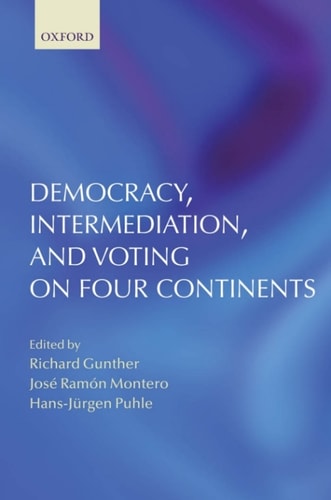
Democracy, Intermediation, and Voting on Four Continents
0
0
As an Amazon Associate and affiliate partner, Menrva Books earns from qualifying purchases. Learn more
Author Description
This book presents the results of systematic comparative analyses of electoral behavior and support for democracy in 13 countries on four continents. It is based on national election surveys held in "old" and "new" democracies in Europe (Germany, Britain, Spain, Greece, Italy, Portugal, Bulgaria), North and South America (the United States, Chile and Uruguay), and Asia (Hong Kong) between 1990 and 2004. It is methodologically innovative, notwithstanding the fact that its core concern with "political intermediation" (i.e., the flow of political information from parties and candidates to voters through the mass-communications media, membership in secondary associations, and direct, face-to-face contacts within interpersonal networks) was first introduced to the study of electoral behavior by Paul Lazarsfeld and his collaborators in the 1940s. In addition to reviving that long-neglected analytical framework, this book breaks new ground by systematically exploring the impact of socio-political values on electoral behavior. It also analyzes the role of political intermediation in forming basic attitudes towards democracy (which are crucial for the consolidation of new democracies), and, in turn, channeling those orientations into various forms of political behavior. Some of the findings presented in this volume are dramatic, and clearly reveal that these channels of information are among the most powerful factors influencing the development of political attitudes and partisan electoral behavior. So, too, are socio-political values in some countries (particularly the United States). This volume is the first book-length product of the now 18-country Comparative National Elections Project.
Menrva's Summary
THE THESIS
This volume investigates how political intermediation—the flow of information through media, associations, and interpersonal networks—shapes electoral behavior and democratic support across diverse global contexts. The authors, HansJürgen Puhle, José Ramón Montero, and Richard Gunther, utilize data from the Comparative National Elections Project to analyze how these communication channels influence political attitudes. By reviving the analytical framework established by Paul Lazarsfeld, the authors argue that intermediation and socio-political values are primary drivers in the consolidation of new democracies and the maintenance of established ones.
THE SCOPE MAP
What You Will Find
- Comparative analysis of 13 countries across Europe, North America, South America, and Asia.
- Application of the political intermediation framework to modern electoral data.
- Quantitative assessment of how socio-political values correlate with partisan behavior.
Scope Limits
- The study is restricted to data collected between 1990 and 2004.
- It focuses primarily on the influence of specific communication channels rather than broader economic or institutional factors.
THE AUTHORITY PERSPECTIVE
Experts recognize this volume as a foundational text for the Comparative National Elections Project, noting its methodological rigor in cross-national survey analysis. Scholars frequently cite the work for its successful integration of historical political communication theory with contemporary electoral data sets.
Page Count:
448
Publication Date:
2007-01-01
Publisher:
Oxford University Press
ISBN-10:
0191525227
ISBN-13:
9780191525223
Comparative Politics
Democracy
Sociology
Community Tags
Similar Books