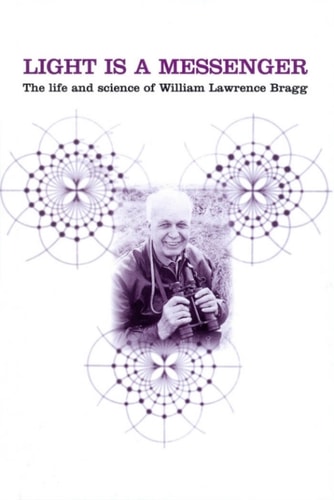
Light Is a Messenger: The Life and Science of William Lawrence Bragg
0
0
As an Amazon Associate and affiliate partner, Menrva Books earns from qualifying purchases. Learn more
Author Description
"Light is a Messenger" is the first biography of William Lawrence Bragg, who was only 25 when he won the 1915 Nobel Prize in Physics - the youngest person ever to win a Nobel Prize. It describes how Bragg discovered the use of X-rays to determine the arrangement of atoms in crystals and his pivotal role in developing this technique to the point that structures of the most complex molecules known to Man - the proteins and nucleic acids - could be solved. Although Bragg's Nobel Prize was for physics, his research profoundly affected chemistry and the new field of molecular biology, of which he became a founding figure. This book explains how these revolutionary scientific events occurred while Bragg struggled to emerge from the shadow of his father, Sir William Bragg, and amidst a career-long rivalry with the brilliant American chemist, Linus Pauling.
Menrva's Summary
THE THESIS
This biography investigates the scientific contributions and personal development of William Lawrence Bragg, the youngest Nobel laureate in physics. Author Graeme K. Hunter examines how Bragg utilized X-ray crystallography to map atomic structures, effectively bridging the gap between physics, chemistry, and the nascent field of molecular biology. The text situates these technical achievements within the context of Bragg's complex relationship with his father and his professional competition with Linus Pauling.
THE SCOPE MAP
What You Will Find
- Detailed account of the development of X-ray crystallography techniques.
- Analysis of the transition from physical physics to molecular biology.
- Examination of the academic rivalry between Bragg and Linus Pauling.
Scope Limits
- The text does not provide an exhaustive technical manual for modern crystallography software.
- It does not focus on the personal lives of Bragg's contemporaries beyond their direct professional impact on his work.
THE AUTHORITY PERSPECTIVE
Experts recognize this work as a comprehensive biographical account that successfully balances technical scientific explanation with human narrative. Readers frequently note that the prose remains accessible to those interested in the history of science while providing sufficient depth for those familiar with the subject matter.
Page Count:
324
Publication Date:
2004-01-01
Publisher:
Oxford University Press
ISBN-10:
0191523828
ISBN-13:
9780191523823
Biography
Science
Chemistry
Earth Sciences
Science History
Physics
Community Tags
Similar Books