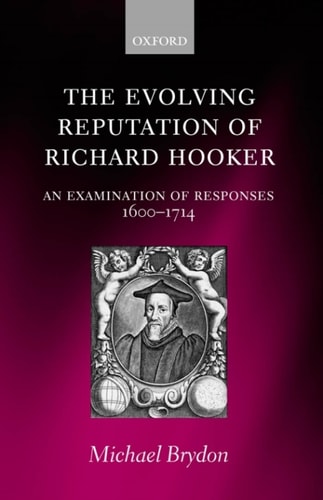
The Evolving Reputation of Richard Hooker: An Examination of Responses, 1600-1714
0
0
As an Amazon Associate and affiliate partner, Menrva Books earns from qualifying purchases. Learn more
Author Description
Richard Hooker has long been viewed as one of England's great theological and political writers. When he died, however, at the end of the sixteenth century, his writings had proved to be something of a damp squib. This book examines, against the background of the political and religious crises of the seventeenth century, how he came to rise from comparative obscurity to be regarded as a universal authority. It will be seen how an unintended alliance of Reformed Protestants, suspicious of Hooker, and Catholics, anxious to exploit his perceived sympathies, led to his establishment as a distinctive, well-regarded English writer. Whilst the boundaries of Hooker's comprehensiveness have expanded and contracted in response to particular situations, the belief that he is an important writer has remained remarkably constant ever since.
Menrva's Summary
THE THESIS
This work investigates the historical process by which Richard Hooker transitioned from a relatively obscure sixteenth-century writer to a foundational authority in English theological and political thought. Michael Brydon, a scholar of early modern intellectual history, utilizes a chronological analysis of seventeenth-century religious and political discourse to demonstrate how Hooker’s reputation was constructed. The author argues that Hooker’s eventual status was not an inherent quality of his work, but rather the result of competing factions—specifically Reformed Protestants and Catholics—appropriating his writings to serve their own polemical agendas.
THE SCOPE MAP
What You Will Find
- A detailed examination of theological responses to Hooker between 1600 and 1714.
- An analysis of the political and religious crises that shaped the reception of the 'Laws of Ecclesiastical Polity'.
- A study of the shifting boundaries of Hooker’s perceived 'comprehensiveness' across different historical contexts.
Scope Limits
- The study does not provide a comprehensive biography of Hooker’s life.
- The analysis does not extend beyond the early eighteenth century to modern interpretations of his work.
THE AUTHORITY PERSPECTIVE
Scholars recognize this text as a rigorous contribution to the study of early modern reception history and the development of the Anglican identity. Readers frequently note the academic density of the prose, which assumes a foundational knowledge of seventeenth-century ecclesiastical debates.
Page Count:
240
Publication Date:
2006-01-01
Publisher:
OUP Oxford
ISBN-10:
0191525499
ISBN-13:
9780191525490
History
Religion
Theology
British History
Intellectual History
Community Tags
Similar Books