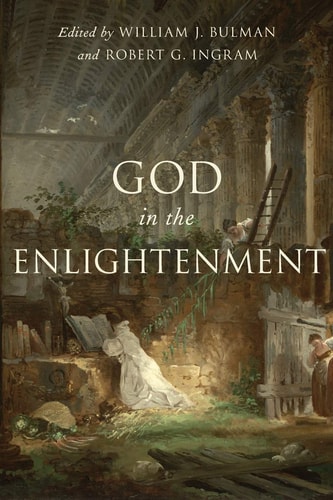
God in the Enlightenment
0
0
As an Amazon Associate and affiliate partner, Menrva Books earns from qualifying purchases. Learn more
Author Description
We have long been taught that the Enlightenment was an attempt to free the world from the clutches of Christian civilization and make it safe for philosophy. The lesson has been well learned. In today's culture wars, both liberals and their conservative enemies, inside and outside the academy, rest their claims about the present on the notion that the Enlightenment was a secularist movement of philosophically driven emancipation. Historians have had doubts about the accuracy of this portrait for some time, but they have never managed to furnish a viable alternative to it-for themselves, for scholars interested in matters of church and state, or for the public at large.In this book, William J. Bulman and Robert G. Ingram bring together recent scholarship from distinguished experts in history, theology, and literature to make clear that God not only survived the Enlightenment but thrived within it as well. The Enlightenment was not a radical break from the past in which Europeans jettisoned their intellectual and institutional inheritance. It was, to be sure, a moment of great change, but one in which the characteristic convictions and traditions of the Renaissance and Reformation were perpetuated to the point of transformation, in the wake of the Wars of Religion and during the early phases of globalization. The Enlightenment's primary imperatives were not freedom and irreligion but peace and prosperity. As a result, Enlightenment could be Christian, communitarian, or authoritarian as easily as it could be atheistic, individualistic, or libertarian.Honing in on the intellectual crisis of the late seventeenth and early eighteenth centuries while moving from Spinoza to Kant and from India to Peru, God in the Enlightenment takes a prism to the age of lights.
Menrva's Summary
THE THESIS
This book investigates the historical accuracy of the Enlightenment as a secularist movement by examining the persistent and evolving role of Christian belief during the period. Editors William J. Bulman and Robert G. Ingram curate a collection of essays from experts in history, theology, and literature to challenge the narrative that the Enlightenment necessitated a break from religious tradition. They argue that the era was defined by a transformation of Renaissance and Reformation convictions rather than their abandonment, positioning peace and prosperity as the primary drivers of the age.
THE SCOPE MAP
What You Will Find
- Analysis of the intellectual crisis spanning the late seventeenth to early eighteenth centuries
- Comparative studies ranging from Spinoza to Kant
- Global perspectives covering regions from India to Peru
- Examination of the intersection between church, state, and institutional inheritance
Scope Limits
- The text does not provide a comprehensive history of all Enlightenment thinkers
- It does not focus on the scientific advancements of the era outside of their theological implications
THE AUTHORITY PERSPECTIVE
Scholars and historians recognize this work as a significant intervention in the ongoing debate regarding the secularization thesis. Readers frequently note the academic density of the prose, which serves as a rigorous resource for those interested in the complex relationship between faith and modernity.
Page Count:
336
Publication Date:
2016-05-23
Publisher:
Oxford University Press
ISBN-10:
0190267089
ISBN-13:
9780190267087
History
Religion
Philosophy
Theology
Intellectual History
God
Enlightenment
Community Tags
Other Editions(2)
Similar Books





Reader Comments
Share Your Thoughts
No comments yet. Be the first to share your thoughts!