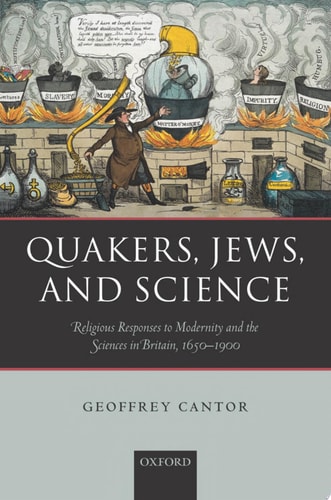
Quakers, Jews, and Science: Religious Responses to Modernity and the Sciences in Britain, 1650-1900
0
0
As an Amazon Associate and affiliate partner, Menrva Books earns from qualifying purchases. Learn more
Author Description
How do science and religion interact? This study examines the ways in which two minorities in Britain - the Quaker and Anglo-Jewish communities - engaged with science. Drawing on a wealth of documentary material, much of which has not been analysed by previous historians, Geoffrey Cantor charts the participation of Quakers and Jews in many different aspects of science: scientific research, science education, science-related careers, and scientific institutions. The responses of both communities to the challenge of modernity posed by innovative scientific theories, such as the Newtonian worldview and Darwin's theory of evolution, are of central interest.
Menrva's Summary
THE THESIS
This study investigates how two distinct religious minorities in Britain, the Quakers and the Anglo-Jewish community, navigated the intersection of their faith traditions and the rise of modern science between 1650 and 1900. Geoffrey Cantor, a historian of science, utilizes a vast array of previously unexamined primary documents to analyze how these groups integrated into scientific research, education, and institutional life. The work argues that these communities did not merely react to scientific shifts but actively participated in the development of the British scientific landscape while maintaining their unique religious identities.
THE SCOPE MAP
What You Will Find
- Historical analysis of Quaker and Anglo-Jewish participation in scientific institutions and careers.
- Examination of community responses to the Newtonian worldview and Darwinian evolution.
- Documentation of science education practices within these specific religious groups.
Scope Limits
- The study focuses exclusively on British communities and does not extend to international Quaker or Jewish scientific engagement.
- The research concludes at 1900 and does not address 20th-century developments in science and religion.
THE AUTHORITY PERSPECTIVE
Historians of science frequently cite this work as a significant contribution to the study of minority engagement with secular intellectual movements. Scholars note the depth of the archival research and the clarity with which Cantor delineates the specific social and religious pressures faced by these two groups.
Page Count:
432
Publication Date:
2005-01-01
Publisher:
OUP Oxford
ISBN-10:
0191534897
ISBN-13:
9780191534898
History
Religion
Science
British History
Sociology
Intellectual History
Community Tags
Similar Books