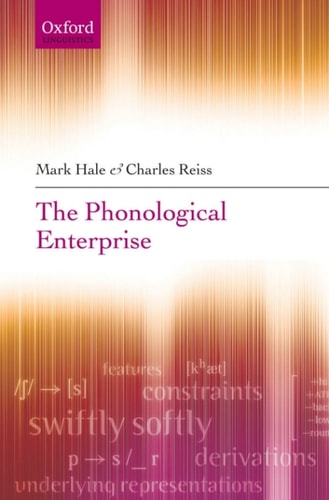
The Phonological Enterprise
0
0
As an Amazon Associate and affiliate partner, Menrva Books earns from qualifying purchases. Learn more
Author Description
This book scrutinizes recent work in phonological theory from the perspective of Chomskyan generative linguistics and argues that progress in the field depends on taking seriously the idea that phonology is best studied as a mental computational system derived from an innate base, phonological Universal Grammar. Two simple problems of phonological analysis provide a frame for a variety of topics throughout the book. The competence-performance distinction and markedness theory are both addressed in some detail, especially with reference to phonological acquisition. Several aspects of Optimality Theory, including the use of Output-Output Correspondence, functionalist argumentation and dependence on typological justification are critiqued. The authors draw on their expertise in historical linguistics to argue that diachronic evidence is often mis-used to bolster phonological arguments, and they present a vision of the proper use of such evidence. Issues of general interest for cognitive scientists, such as whether categories are discrete and whether mental computation is probabilistic are also addressed. The book ends with concrete proposals to guide future phonological research. The breadth and depth of the discussion, ranging from details of current analyses to the philosophical underpinnings of linguistic science, is presented in a direct style with as little recourse to technical language as possible.
Menrva's Summary
THE THESIS
This book investigates whether phonology should be modeled as a mental computational system derived from an innate, universal grammar rather than through functionalist or typological frameworks. The authors, Charles Reiss and Mark Hale, utilize their extensive backgrounds in historical linguistics and generative theory to challenge prevailing trends in phonological analysis. They argue that the field must return to a rigorous, competence-based approach to mental computation, critiquing current reliance on probabilistic models and output-oriented correspondence theories.
THE SCOPE MAP
What You Will Find
- A critique of Optimality Theory and its reliance on functionalist argumentation.
- Analysis of the competence-performance distinction in phonological acquisition.
- A framework for the proper application of diachronic evidence in linguistic research.
- Discussions on the nature of mental categories and computational processes.
Scope Limits
- The text does not provide a comprehensive survey of non-generative phonological theories.
- It does not offer a beginner-level introduction to basic phonological notation or phonetic transcription.
THE AUTHORITY PERSPECTIVE
Experts in the field recognize this work as a significant, albeit polemical, contribution to the generative phonology debate. Readers frequently note the academic density of the prose and the authors' uncompromising stance against functionalist methodologies in modern linguistics.
Page Count:
336
Publication Date:
2008-01-01
Publisher:
Oxford University Press
ISBN-10:
0191538590
ISBN-13:
9780191538599
Linguistics
Academic
Phonology
English
English & College Success