Corporate Governance: What Can Be Learned from Japan?
0
0
As an Amazon Associate and affiliate partner, Menrva Books earns from qualifying purchases. Learn more
Author Description
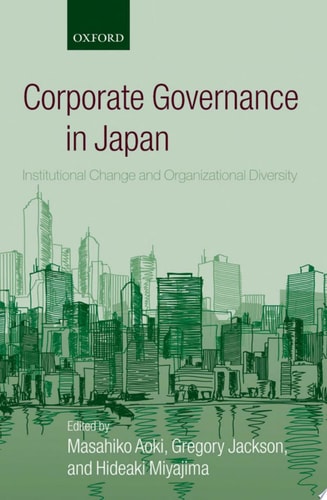
This book explores current thinking on corporate governance by way of a detailed study of the governance practices of fourteen Japanese companies. The author was granted extensive access to these Japanese companies, as well as to their partner companies, their shareholders, and their banks, and is therefore able to provide a detailed insight into the way that Japanese companies are actually governed on a day-to-day basis. The book suggests that current mainstream conceptualizations of corporate governance are inadequate, as they do not help to understand the way that these Japanese companies are directed and controlled in practice. In the majority of cases, governance operates through a system which draws on the reciprocal obligations, responsibilities, and trust generated in everyday interactions at the individual and organizational level. The conclusions of the research have important implications not only for our understanding of the Japanese system of corporate governance, but also for international corporate governance policy and research in general. In particular, the book commends greater recognition that alongside the currently dominant concern 'controlling' the behaviour of company managers, the governance of companies might equally be considered in terms of the responsibilities, reciprocal obligations, and trust inherent in everyday interactions. The book is equally accessible and relevant to both academics and to those involved with corporate governance issues on a day-to-day basis, including financial services providers, lawyers, policymakers, and company directors.
Menrva's Summary
THE THESIS
This book investigates whether mainstream conceptualizations of corporate governance are sufficient to explain the actual operational realities of Japanese firms. Author Simon Learmount utilizes extensive primary research and direct access to fourteen Japanese companies, their partners, shareholders, and banks to challenge existing governance models. He argues that current frameworks, which focus heavily on controlling manager behavior, fail to account for the role of reciprocal obligations, trust, and interpersonal relationships in directing and controlling organizations.
THE SCOPE MAP
What You Will Find
- Detailed case studies of fourteen Japanese companies and their associated networks
- An analysis of governance through the lens of trust and reciprocal responsibility
- Implications for international corporate governance policy and academic research
Scope Limits
- The study does not provide a comprehensive survey of all Japanese industries
- The research does not offer a prescriptive manual for implementing Japanese-style governance in Western markets
THE AUTHORITY PERSPECTIVE
Experts and practitioners recognize this work as a significant contribution to the comparative study of corporate governance systems. Readers frequently note that the text provides a nuanced alternative to standard agency-theory perspectives by highlighting the importance of social capital in organizational control.
Page Count:
192
Publication Date:
2002-01-01
Publisher:
Oxford University Press
ISBN-10:
0191531014
ISBN-13:
9780191531019
Business
Economics
Management
Japan
International business
Principles of Management
Corporate governance
Community Tags
Similar Books