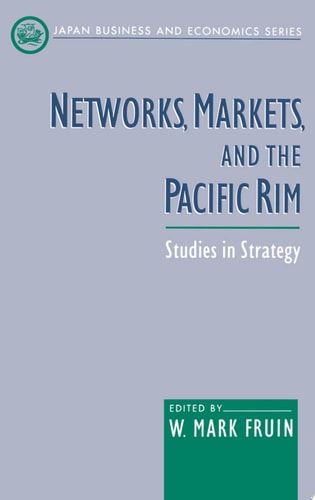
Networks, Markets, and the Pacific Rim: Studies in Strategy
0
0
As an Amazon Associate and affiliate partner, Menrva Books earns from qualifying purchases. Learn more
Author Description
Despite the negative press Asian economies have received in connection with the recent financial crisis, their record of spectacular growth over the past few decades remains irrefutable. In an effort to provide a rich, textured analysis of these economies, editor W. Mark Fruin presents a collection of essays that explores the wide range of network organizations that have been established in the Pacific Rim.Conventional studies of economic organization have tended to center on markets and hierarchies, the two forms of organization most common in the West. But today the world moves too quickly and too unpredictably for the idealized organizations of microeconomic theory to keep up. It is no accident that the region that has generated the world's most explosive economic growth is also the region where network organizations--sets of independent actors who cooperate frequently for mutual advantage--are most pervasive. Rapid economic, social, and technical changes favor the formation of network organizations, and vice versa.The contributors to this volume identify and elucidate four basic types of networks: naturally occurring networks, market replacing networks, hierarchy replacing networks, and market enhancing networks. They show how all of these have been shaped by the history, government, legal system, and culture of each country under consideration. These network organizations allow the authors to compare and contrast network forms in China, Japan, South Korea, Taiwan, and the United States according to features such as degrees of formalization, rule definition, and market conformance.The works collected here make an important contribution to a networks-markets- hierarchies framework that recognizes and emphasizes the diversity of organizational forms and behaviors. A unique resource for scholars and professionals in the fields of management and economics, this book enables a complex analysis of one of the world's fastest growing and most theoretically challenging regions.
Menrva's Summary
THE THESIS
This volume investigates how network-based organizational structures in the Pacific Rim have facilitated rapid economic growth and how they challenge traditional Western microeconomic theories of markets and hierarchies. Editor W. Mark Fruin compiles a series of scholarly essays that examine the intersection of culture, government, and economic behavior. The contributors argue that the prevalence of cooperative network organizations in Asia provides a more flexible and responsive model for navigating unpredictable global markets than rigid hierarchical structures.
THE SCOPE MAP
What You Will Find
- A comparative analysis of network forms across Japan, China, South Korea, Taiwan, and the United States.
- A classification framework identifying four distinct network types: naturally occurring, market replacing, hierarchy replacing, and market enhancing.
- Examination of how legal systems, history, and cultural norms influence the formalization and rule definition of business organizations.
- Theoretical integration of network-market-hierarchy models to explain organizational diversity in fast-growing economies.
THE AUTHORITY PERSPECTIVE
Experts recognize this collection as a significant contribution to the study of organizational behavior and comparative economic systems. Readers frequently note the academic density of the prose, which serves as a specialized resource for scholars and professionals interested in Pacific Rim economic strategy.
Page Count:
336
Publication Date:
1998-11-19
Publisher:
Oxford University Press
ISBN-10:
0195117204
ISBN-13:
9780195117202
Economics
Business
Management
Japan
International relations
Pacific Rim
Japan commerce
Community Tags
Other Editions(2)

Similar Books













Reader Comments
Share Your Thoughts
No comments yet. Be the first to share your thoughts!