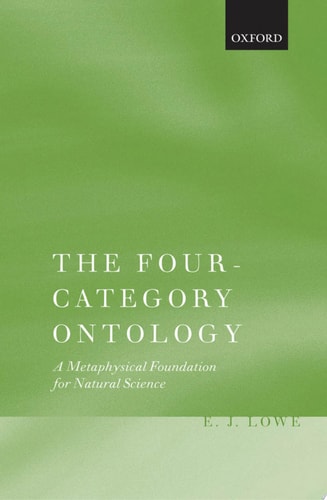
The Four-Category Ontology: A Metaphysical Foundation for Natural Science
0
0
As an Amazon Associate and affiliate partner, Menrva Books earns from qualifying purchases. Learn more
Author Description
E. J. Lowe sets out and defends his theory of what there is. His four-category ontology is a metaphysical system that recognizes two fundamental categorial distinctions which cut across each other to generate four fundamental ontological categories. The distinctions are between the particular and the universal and between the substantial and the non-substantial. The four categories thus generated are substantial particulars, non-substantial particulars, substantial universals and non-substantial universals. Non-substantial universals include properties and relations, conceived as universals. Non-substantial particulars include property-instances and relation-instances, otherwise known as non-relational and relational tropes or modes. Substantial particulars include propertied individuals, the paradigm examples of which are persisting, concrete objects. Substantial universals are otherwise known as substantial kinds and include as paradigm examples natural kinds of persisting objects. This ontology has a lengthy pedigree, many commentators attributing it to Aristotle on the basis of certain passages in his apparently early work, the Categories. At various times during the history of Western philosophy, it has been revived or rediscovered, but it has never found universal favour, perhaps on account of its apparent lack of parsimony as well as its commitment to universals. In pursuit of ontological economy, metaphysicians have generally preferred to recognize fewer than four fundamental ontological categories. However, Occam's razor stipulates only that we should not multiply entities beyond necessity; Lowe argues that the four-category ontology has an explanatory power unrivalled by more parsimonious systems, and that this counts decisively in its favour. He shows that it provides a powerful explanatory framework for a unified account of causation, dispositions, natural laws, natural necessity and many other related matters, such as the semantics of counterfactual con
Menrva's Summary
THE THESIS
This work investigates whether a four-category ontology provides a more robust explanatory framework for natural science than more parsimonious metaphysical systems. E. J. Lowe, a prominent analytic philosopher, utilizes historical Aristotelian foundations to construct a system based on two primary distinctions: particular versus universal and substantial versus non-substantial. He argues that while this system lacks the simplicity of competing theories, its superior ability to account for causation, natural laws, and dispositions justifies its adoption.
THE SCOPE MAP
What You Will Find
- A formal classification of entities into substantial particulars, non-substantial particulars, substantial universals, and non-substantial universals.
- An analysis of the relationship between natural kinds, property-instances, and concrete objects.
- A defense of the four-category system against objections regarding ontological economy and Occam's razor.
Scope Limits
- The text does not provide an exhaustive history of all metaphysical systems.
- It does not address non-Western ontological traditions.
THE AUTHORITY PERSPECTIVE
Philosophers frequently cite this text as a rigorous defense of neo-Aristotelian metaphysics. Readers often note the high level of technical density, making it a specialized resource for those already familiar with analytic ontology.
Page Count:
240
Publication Date:
2006-01-01
Publisher:
Clarendon Press
ISBN-10:
0191531170
ISBN-13:
9780191531170
Philosophy
Metaphysics
Science
Ontology
Academic
Community Tags
Similar Books