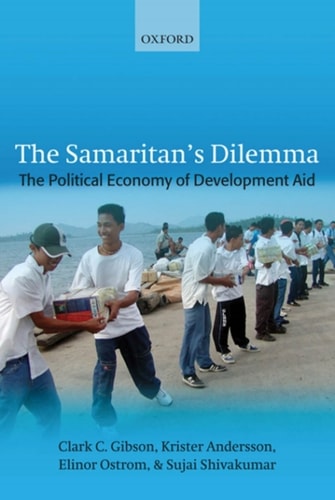
The Samaritan's Dilemma: The Political Economy of Development Aid
0
0
As an Amazon Associate and affiliate partner, Menrva Books earns from qualifying purchases. Learn more
Author Description
What's wrong with foreign aid? Many policymakers, aid practitioners, and scholars have called into question its ability to increase economic growth, alleviate poverty, or promote social development. At the macro level, only tenuous links between development aid and improved living conditions have been found. At the micro level, only a few programs outlast donor support and even fewer appear to achieve lasting improvements. The authors of this book argue that much of aid's failure is related to the institutions that structure its delivery. These institutions govern the complex relationships between the main actors in the aid delivery system and often generate a series of perverse incentives that promote inefficient and unsustainable outcomes. In their analysis, the authors apply the theoretical insights of the new institutional economics to several settings. First, they investigate the institutions of Sida, the Swedish aid agency, to analyze how that aid agency's institutions can produce incentives inimical to desired outcomes, contrary to the desires of its own staff. Second, the authors use cases from India, a country with low aid dependence, and Zambia, a country with high aid dependence, to explore how institutions on the ground in recipient countries also mediate the effectiveness of aid. Throughout the book, the authors offer suggestions about how to improve aid's effectiveness. These suggestions include how to structure evaluations in order to improve outcomes, how to employ agency staff to gain from their on-the-ground experience, and how to engage stakeholders as "owners" in the design, resource mobilization, learning, and evaluation processes of development assistance programs.
Menrva's Summary
THE THESIS
This book investigates why foreign aid frequently fails to achieve its stated goals of economic growth and poverty alleviation by examining the institutional structures that govern aid delivery. The authors, including Nobel laureate Elinor Ostrom, utilize the framework of new institutional economics to argue that perverse incentives within aid agencies and recipient country systems undermine project sustainability. By analyzing the complex relationships between donors, practitioners, and local stakeholders, the text provides a systematic critique of current development assistance models.
THE SCOPE MAP
What You Will Find
- Institutional analysis of the Swedish International Development Cooperation Agency (Sida)
- Comparative case studies of aid effectiveness in India and Zambia
- Frameworks for restructuring aid evaluation and stakeholder engagement
- Application of new institutional economics to international development policy
Scope Limits
- The analysis does not provide a comprehensive history of all global aid programs
- The text does not focus on private charitable aid or non-governmental organization (NGO) specific operations outside of state-sponsored frameworks
THE AUTHORITY PERSPECTIVE
Experts recognize this work as a foundational text for understanding the political economy of development aid through an institutional lens. Readers frequently note the academic rigor of the prose, which makes it a standard reference for students and practitioners in public policy and international development.
Page Count:
288
Publication Date:
2005-01-01
Publisher:
Oxford University Press
ISBN-10:
0191535338
ISBN-13:
9780191535338
Economics
Developing Countries
International relations
Public Policy
Community Tags
Similar Books