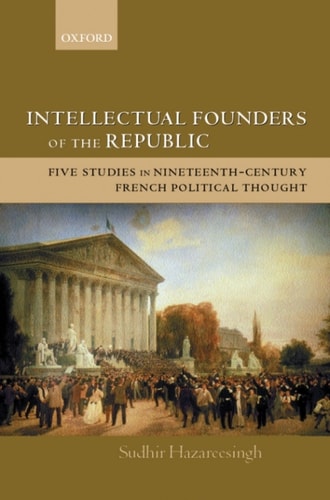
Intellectual Founders of the Republic: Five Studies in Nineteenth-Century French Political Thought
0
0
As an Amazon Associate and affiliate partner, Menrva Books earns from qualifying purchases. Learn more
Author Description
This innovative study of French political culture re-examines the origins of modern republicanism through the lives and political thought of five nineteenth-century intellectuals: Jules Barni, Charles Dupont-White, Emile Littré, Eugène Pelletan, and Etienne Vacherot. By their writings and their political practices at the local, national, international levels these thinkers made major contributions to the founding of the new republican order in France. Drawing on a range of archival and published sources, the book sheds new light on classical republican thinking on such key issues as the interpretation of the 1789 Revolution, the definition of citizenship, the meaning of patriotism, the relationship between central government and local democracy, the value of individual liberty, and the place of education and religion in publica and private life. These five studies also break new ground in the conceptualization of nineteenth-century French intellectual history. The writings of these thinkers demonstrate the ideological pluralism and diversity of moderate French republican thought during this period. Positivism appears as an important and influential doctrine, but its hegemonic aspirations were successfully resisted by the abiding incluences of Saint-Simonism, socialism, doctrinaire liberalism, and neo-Kantianism. It emerges that the ideological potency of republican doctrine lay in its complexity and sophistication, as reflected in its capacity to effect a synthesis among these different approaches. Through its analysis of the writings and political practices of these five thinkers Intellectual Founders of the Republic offers critical insights into the history of political thought as well as modern French republicanism. It underlines both the significance of contextuality in the interpretation of political discourse, and the continuing relevance of classical republicanism in making sense of contemporary moral and political dilemmas.
Menrva's Summary
THE THESIS
This work investigates the origins and ideological complexity of nineteenth-century French republicanism through the political contributions of five key intellectuals. Author Sudhir Hazareesingh, a specialist in French political culture, utilizes archival research and primary texts to demonstrate that moderate republican thought was not a monolithic doctrine but a sophisticated synthesis of diverse influences including liberalism, socialism, and positivism. By examining the lives of Jules Barni, Charles Dupont-White, Emile Littré, Eugène Pelletan, and Etienne Vacherot, the book argues that these thinkers were instrumental in shaping the foundational values of the modern French state.
THE SCOPE MAP
What You Will Find
- Detailed biographical and intellectual profiles of five nineteenth-century French thinkers.
- Analysis of republican discourse regarding the 1789 Revolution, citizenship, and secularism.
- Examination of the interplay between central government authority and local democratic practices.
- Discussion of the influence of Saint-Simonism, neo-Kantianism, and doctrinaire liberalism.
Scope Limits
- The study focuses specifically on moderate republicanism rather than radical or revolutionary movements of the era.
- The analysis is limited to the intellectual contributions of the five selected figures rather than a comprehensive survey of all French political actors.
THE AUTHORITY PERSPECTIVE
Scholars and historians recognize this text as a significant contribution to the study of French intellectual history, particularly for its nuanced treatment of ideological pluralism. Readers frequently note the academic density of the prose, which is best suited for those with a background in European political philosophy.
Page Count:
354
Publication Date:
2001-01-01
Publisher:
OUP Oxford
ISBN-10:
019153014X
ISBN-13:
9780191530142
History
Intellectual History
Nineteenth century
Political Philosophy
French History
Community Tags
Other Editions(2)

Similar Books



Reader Comments
Share Your Thoughts
No comments yet. Be the first to share your thoughts!