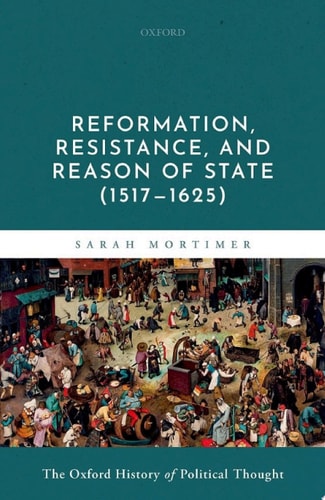
Reformation, Resistance, and Reason of State (1517-1625)
0
0
As an Amazon Associate and affiliate partner, Menrva Books earns from qualifying purchases. Learn more
Author Description
The period 1517-1625 was crucial for the development of political thought. During this time of expanding empires, religious upheaval, and social change, new ideas about the organisation and purpose of human communities began to be debated. In particular, there was a concern to understand the political or civil community as bounded, limited in geographical terms and with its own particular structures, characteristics and history. There was also a growing focus, in the wake of the Reformation, on civil or political authority as distinct from the church or religious authority. The concept of sovereignty began to be used, alongside a new language of reason of state--in response, political theories based upon religion gained traction, especially arguments for the divine right of kings. In this volume Sarah Mortimer highlights how, in the midst of these developments, the language of natural law became increasingly important as a means of legitimising political power, opening up scope for religious toleration. Drawing on a wide range of sources from Europe and beyond, Sarah Mortimer offers a new reading of early modern political thought. She makes connections between Christian Europe and the Muslim societies that lay to its south and east, showing the extent to which concerns about the legitimacy of political power were shared. Mortimer demonstrates that the history of political thought can both benefit from, and remain distinctive within, the wider field of intellectual history. The books in The Oxford History of Political Thought series provide an authoritative overview of the political thought of a particular era. They synthesize and expand major developments in scholarship, covering canonical thinkers while placing them in a context of broader traditions, movements, and debates. The history of political thought has been transformed over the last thirty to forty years. Historians still return to the constant landmarks of writers such as Plato, Machiavelli, Hobbes, Rouss
Menrva's Summary
THE THESIS
This volume investigates how the intersection of religious upheaval, the rise of sovereignty, and the emergence of reason of state transformed political legitimacy between 1517 and 1625. Sarah Mortimer, a specialist in early modern intellectual history, utilizes a broad array of primary sources to argue that natural law became a critical framework for reconciling political authority with religious diversity. By situating European debates within a global context that includes neighboring Muslim societies, she demonstrates how shared concerns regarding the limits of power shaped the development of modern political thought.
THE SCOPE MAP
What You Will Find
- Analysis of the transition from ecclesiastical to civil authority during the Reformation.
- Examination of the development of sovereignty and reason of state concepts.
- Comparative study of political legitimacy in Christian Europe and neighboring Muslim societies.
- Discussion of the role of natural law in facilitating early arguments for religious toleration.
Scope Limits
- The analysis is strictly bounded by the years 1517 to 1625.
- The text focuses on intellectual history rather than a comprehensive narrative of political events or military history.
THE AUTHORITY PERSPECTIVE
Scholars recognize this volume as a significant contribution to the Oxford History of Political Thought series, valued for its ability to synthesize complex intellectual traditions. Readers frequently note the academic density of the prose, which is intended for students and researchers familiar with early modern political theory.
Page Count:
311
Publication Date:
2021-01-01
Publisher:
OUP Oxford
ISBN-10:
0192659669
ISBN-13:
9780192659668
History
Intellectual History
Reformation
History - Modern
Political Philosophy
Community Tags
Other Editions(2)

Similar Books





Reader Comments
Share Your Thoughts
No comments yet. Be the first to share your thoughts!