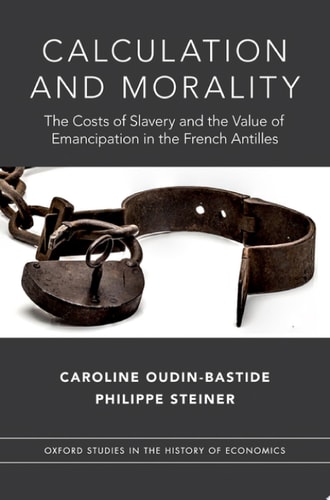
Calculation and Morality
0
0
As an Amazon Associate and affiliate partner, Menrva Books earns from qualifying purchases. Learn more
Author Description
Debates about whether to maintain or abolish slavery revolved around two key values: the morality of enslaving other human beings and the economic benefits and costs of slavery as compared to free labor. Various and conflicting arguments were presented by abolitionists, colonists, and administrators in slave-holding societies, all of whom used calculations about the relative cost and productivity of slavery to defend their own point of view in an impassioned debate. In Calculation and Morality, Caroline Oudin-Bastide and Philippe Steiner consider how economic calculations, estimations, and arguments informed the long debate over French slavery between 1771 and 1848. They show how calculation was introduced into moral debate and became a critical social object in regard both to its consistency and its manifest effects. To do so they trace a process in which phenomena were classified into groups, becoming a category, and then how metrics and calculations were used to analyze the possible effects of emancipating slaves in French colonies. Abolitionists sought to demonstrate that it was in the interest of slaveowners and/or the entire nation to employ free labour in the colonies, and to show the irrationality of the colonial and metropolitan defenders of servitude; their aim was to enlighten various parties as to their real interest, and how that real interest coincided with justice. In turn, colonists accused those opposed to slavery of being blinded by their own philanthropic principles and insisted on the rationality of the slave system as the only means of meeting the interests of everyone, including slaves, at least in the short and medium term. Oudin-Bastide and Steiner closely examine the positions and reasoning of such influential French thinkers as Pierre Samuel du Pont de Nemours, Anne Robert Jacques Turgot, Antoine Nicolas de Condorcet, Simonde de Sismondi, Jean Baptiste Say, and Alexis de Tocqueville. In doing so they shed light on the interaction of moral principles and economic reasoning.
Menrva's Summary
THE THESIS
This work investigates how economic calculation and quantitative reasoning were integrated into the moral and political debates surrounding the abolition of slavery in French colonies between 1771 and 1848. Caroline Oudin-Bastide and Philippe Steiner, both scholars in sociology and economic history, examine how proponents and opponents of slavery utilized metrics to justify their positions. By analyzing the rhetoric of influential French thinkers, the authors demonstrate how economic rationality became a central instrument in the struggle to define justice and national interest during the transition from slave labor to free labor.
THE SCOPE MAP
What You Will Find
- Analysis of economic arguments regarding the productivity and cost of slave versus free labor.
- Examination of the intellectual contributions of figures such as Turgot, Condorcet, Say, and Tocqueville.
- A historical framework tracing the evolution of abolitionist discourse in France.
Scope Limits
- The text focuses primarily on the French colonial context and does not provide a comparative analysis of British or American abolitionist economic models.
- The study is limited to the period between 1771 and 1848 and does not cover the post-emancipation economic outcomes in detail.
THE AUTHORITY PERSPECTIVE
Scholars in the fields of economic history and sociology recognize this text as a rigorous examination of the intersection between moral philosophy and political economy. Readers frequently note the academic density of the prose, which provides a detailed look at how quantitative metrics were weaponized in historical social debates.
Page Count:
320
Publication Date:
2019-01-01
Publisher:
Oxford University Press
ISBN-10:
0190856866
ISBN-13:
9780190856861
History
Economics
Political Philosophy
Social Science
Slavery
French History
Community Tags
Similar Books