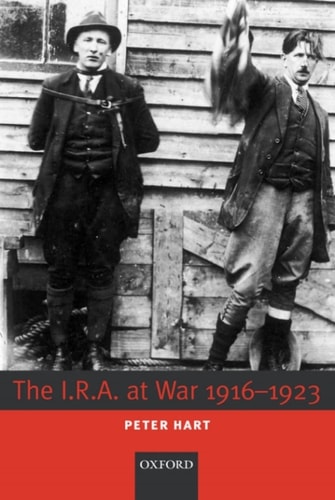
The I.R.A. at War: 1916-1923
0
0
As an Amazon Associate and affiliate partner, Menrva Books earns from qualifying purchases. Learn more
Author Description
Between 1916 and 1923, Ireland experienced rebellion and mass mobilization, guerrilla and civil war, partition and ethnic conflict, and the transfer of power from British to Irish governments. The essays in The I.R.A. at War propose a new history of this Irish revolution: one that encompasses the whole of the island as well as Britain, all of the violence and its consequences, and the entire period from the Easter Rising to the end of the Civil War. When did the revolution start and when did it end? Why was it so violent and why were some areas so much worse than others? Why did the I.R.A. mount a terror campaign in England and Scotland but refuse to assassinate British politicians? Where did it get its guns? Was it democratic? What kind of people became guerrillas? What kind of people did they kill? Were Protestants ethnically cleansed from southern Ireland? Did a pogrom take place against Belfast Catholics? These and other questions are addressed using extensive new data on those involved and their actions, including the first complete figures for victims of the revolution. These events have never been numbered among the world's great revolutions, but in fact Irish republicans were global pioneers. Long before Mao or Tito, Sinn Féin and the Irish Republican Army were the first to use a popular political front to build a parallel underground state coupled with sophisticated guerrilla and international propaganda and fund-raising campaigns. Ireland's is also perhaps the best documented revolution in modern history, so that almost any question can be answered, from who joined the I.R.A. to who ordered the assassination of Sir Henry Wilson. The intimacy and precision with which we are able to reconstruct and analyse what happened make this a key site for understanding not just Irish, but world history.
Menrva's Summary
THE THESIS
This work investigates the operational mechanics, violence, and political evolution of the Irish Republican Army during the revolutionary period of 1916 to 1923. Peter Hart, a historian specializing in the Irish revolution, utilizes extensive archival data and statistical analysis to re-examine the conflict. The book argues that the Irish revolution functioned as a precursor to modern guerrilla warfare, employing a sophisticated combination of political fronts, underground state-building, and international propaganda that predated later global revolutionary movements.
THE SCOPE MAP
What You Will Find
- Statistical analysis of casualties and victim demographics across the island of Ireland.
- Examination of the logistical networks for arms procurement and international fundraising.
- Comparative analysis of regional violence patterns and the effectiveness of guerrilla tactics.
Scope Limits
- The text focuses primarily on the military and political structures of the IRA rather than providing a comprehensive biographical account of individual leaders.
THE AUTHORITY PERSPECTIVE
Historians and scholars of Irish history frequently cite this work for its rigorous use of quantitative data and its challenge to traditional nationalist narratives. Readers often note the academic density of the prose, which provides a detailed, evidence-based assessment of the revolutionary period.
Page Count:
296
Publication Date:
2004-01-01
Publisher:
Oxford University Press
ISBN-10:
0191530948
ISBN-13:
9780191530944
History
Irish History
Ireland
Irish Question
Military History
Autonomy and independence movements
European History
Revolutionary Studies
Community Tags
Similar Books