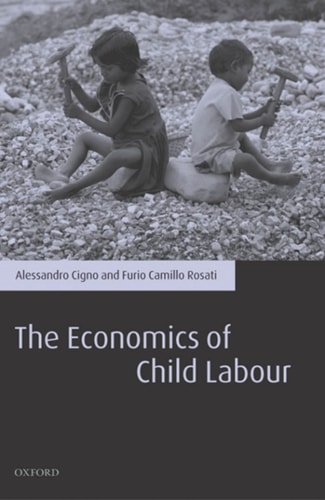
The Economics of Child Labour
0
0
As an Amazon Associate and affiliate partner, Menrva Books earns from qualifying purchases. Learn more
Author Description
Children throughout the world are engaged in a great number of activities classifiable as work. These range from relatively harmless, even laudable, activities like helping parents in their domestic chores, to morally and physically dangerous ones like soldiering and prostitution. If we leave out the former, we are left with what are generally called "economic" activities. Only a small minority, less than 4 percent of all working children, are estimated to be engaged in what ILO defines as the "unconditional" worst forms of child labour. The absolute number of children estimated to be engaged in the latter is, however, a stunning 8.4 million. Should we only be concerned about the worst forms of child labour? Most forms of child labour other than the worst ones have valuable learning-by-doing elements. Furthermore, child labour produces current income. If the family is credit rationed, child labour relaxes the liquidity constraint and increases current consumption. There is thus a trade-off between present and future consumption. To the extent that current consumption has a positive effect on future health (hence, on the child's future earning capacity and, more generally, utility), this trade-off may be lower than one might think. This book provides a blend of theory, empirical analysis and policy discussion. The first three chapters develop a fairly comprehensive theory of child labour, and related variables such as fertility, and infant mortality. Chapter 4, concerned with the effects of trade, contains both theory and cross-country empirical evidence. The remaining chapters are country studies, aimed at illustrating and testing different aspects of the theory in different geographical contexts. These chapters apply the latest developments in microeconometric methodology for dealing with endogeneity, unobserved heterogeneity, and the evaluation of public intervention.
Menrva's Summary
THE THESIS
This book investigates the complex economic drivers of child labour and the trade-offs families face between immediate income and long-term human capital development. The authors, Alessandro Cigno and Furio C. Rosati, utilize a combination of theoretical modeling and empirical microeconometric analysis to challenge simplistic views of child labour. They argue that child labour often functions as a rational response to credit constraints within impoverished households, necessitating nuanced policy interventions rather than blanket prohibitions.
THE SCOPE MAP
What You Will Find
- Theoretical frameworks linking child labour to fertility rates and infant mortality
- Analysis of the impact of international trade on child labour prevalence
- Microeconometric methodologies for addressing endogeneity and unobserved heterogeneity
- Comparative country studies illustrating diverse economic contexts
Scope Limits
- The text does not provide a comprehensive historical survey of child labour legislation
- It does not focus on the psychological or sociological impacts of child labour outside of economic utility
THE AUTHORITY PERSPECTIVE
Experts recognize this work as a rigorous academic contribution to development economics that successfully bridges the gap between abstract theory and empirical application. Readers frequently note the technical density of the prose, which assumes a foundational understanding of econometrics and economic modeling.
Page Count:
264
Publication Date:
2005-01-01
Publisher:
Oxford University Press
ISBN-10:
0191532606
ISBN-13:
9780191532603
Economics
Social policy
Public Policy
Sociology
Child labor
Community Tags
Similar Books