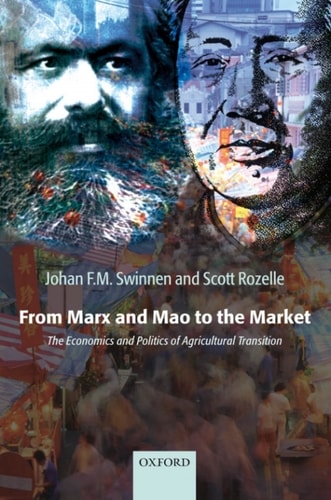
From Marx and Mao to the Market: The Economics and Politics of Agricultural Transition
0
0
As an Amazon Associate and affiliate partner, Menrva Books earns from qualifying purchases. Learn more
Author Description
The emergence of China as a global economic powerhouse, the uncertain path of Russia towards a market economy, and the integration of ten Central and Eastern European countries into the European Union (EU) have occupied the minds and agendas of many policy-makers, business leaders and scholars from around the world at the end of the twentieth and the beginning of the twenty-first century. Twenty years ago these developments were unimaginable. The impact of these changes is so vast that the importance of understanding the forces that unleashed this process, how these changes became possible, and what the lessons are for other developing countries, cannot be overestimated. This book is the first effort to analyze the economics and politics of agricultural reforms by comparing the reform processes, their causes and their effects across this vast region. The authors draw on a vast set of studies and new data, which compare reforms and economic impacts in more than 25 countries, to come up with a series of conclusions and implications on the role of economic reforms in growth, and the importance of initial conditions and political constraints in explaining the choices that were made and their effects. The book analyzes some of the most successful sets of agricultural policies in history that have lifted people out of poverty, raising productivity and incomes by staggering amounts. At the same time the book explains the reasons behind dramatic failures in policy processes and reforms that caused hunger, poverty and which had devastating effects on economic growth and development for millions of other people.
Menrva's Summary
THE THESIS
This book investigates the underlying economic and political drivers that dictated the success or failure of agricultural reforms during the transition from centrally planned to market-oriented economies. The authors, Johan F. M. Swinnen and Scott Rozelle, utilize a comparative analytical framework to examine how initial conditions and political constraints influenced policy outcomes across more than 25 countries. By synthesizing extensive data sets, they evaluate the mechanisms that led to significant productivity gains in some regions while identifying the structural causes of policy failures that resulted in economic stagnation and food insecurity in others.
THE SCOPE MAP
What You Will Find
- Comparative analysis of agricultural reform processes in China, Russia, and Central and Eastern Europe.
- Quantitative assessment of the relationship between economic policy, growth, and poverty reduction.
- Examination of the role of initial institutional conditions in shaping reform trajectories.
- Synthesis of data from over 25 countries spanning the late 20th and early 21st centuries.
Scope Limits
- The analysis focuses primarily on agricultural sectors rather than broader industrial or macroeconomic reforms.
- The study does not provide exhaustive country-specific histories, prioritizing cross-national comparative trends instead.
THE AUTHORITY PERSPECTIVE
Experts recognize this work as a comprehensive comparative study that bridges the gap between political science and agricultural economics. Readers frequently note the academic density of the prose, which serves as a rigorous resource for scholars and policy analysts interested in transition economies.
Page Count:
240
Publication Date:
2006-01-01
Publisher:
OUP Oxford
ISBN-10:
0191537225
ISBN-13:
9780191537226
History
Economics
International relations
Community Tags
Other Editions(2)
Similar Books