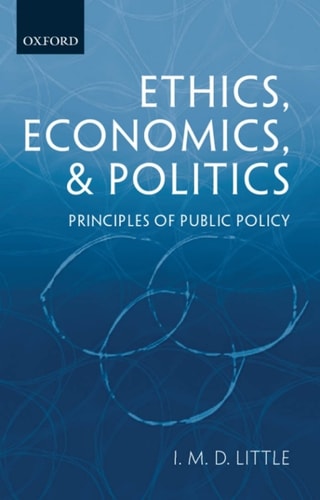
Ethics, Economics, and Politics: Principles of Public Policy
0
0
As an Amazon Associate and affiliate partner, Menrva Books earns from qualifying purchases. Learn more
Author Description
This book studies the interfaces of ethics, economics, and politics. Public policy issues involve all three of these subjects. Although it may be seen as suggesting the nucleus of a joint university course, the book is accessible to and should interest all those concerned with political decisions. Any such decision needs a criterion for judging whether one action or outcome is better than another. Even a dictator must to some extent be concerned about the economic welfare of the citizens; and a democratic government more so. But how is a person's economic welfare to be judged? Furthermore, any political decision affects the economic welfare of different people differently. How then is the welfare of a community to be judged? This is an ethical question. Underlying any coherent public policy there must be a relevant moral code.
Menrva's Summary
THE THESIS
This book investigates the foundational intersection of ethics, economics, and political decision-making to determine how public policy can be evaluated and justified. I. M. D. Little, an economist, examines the necessity of moral frameworks in assessing economic welfare. He argues that because political actions inevitably impact different groups in disparate ways, a coherent ethical criterion is required to judge the outcomes of public policy.
THE SCOPE MAP
What You Will Find
- Analysis of the relationship between individual economic welfare and collective social outcomes
- Theoretical frameworks for evaluating the morality of political decisions
- Discussion on the necessity of moral codes in governance
Scope Limits
- Does not provide a comprehensive history of political philosophy
- Does not offer specific policy prescriptions for contemporary legislative issues
THE AUTHORITY PERSPECTIVE
Experts recognize this work as a concise, foundational text for those seeking to understand the philosophical underpinnings of economic policy. Readers frequently note the clarity of the prose, which makes complex ethical dilemmas accessible to both students and practitioners of political science.
Page Count:
162
Publication Date:
2002-01-01
Publisher:
OUP Oxford
ISBN-10:
0191531405
ISBN-13:
9780191531408
Philosophy
Economics
Ethics
Public Policy
Community Tags
Similar Books