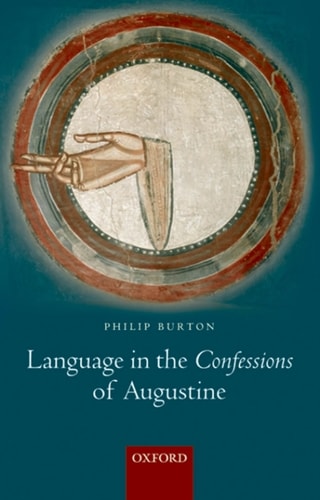
Language in the Confessions of Augustine
0
0
As an Amazon Associate and affiliate partner, Menrva Books earns from qualifying purchases. Learn more
Author Description
Philip Burton explores Augustine's treatment of language in his Confessions - a major work of Western philosophy and literature, with continuing intellectual importance. One of Augustine's key concerns is the story of his own encounters with language: from his acquisition of language as a child, through his career as schoolboy orator then star student at Carthage, to professor of rhetoric at Carthage and Rome. Having worked his way up to the eminence of Court Orator to the Roman Emperor at Milan, Augustine rediscovered the catholic Christianity of his childhood - and decided that this was incompatible with his rhetorical profession. Over the next ten years, he gradually reinvents himself as a different sort of language professional: a Christian intellectual, commentating on Scripture and preaching to his flock.
Menrva's Summary
THE THESIS
This work investigates how Augustine of Hippo conceptualizes the nature, acquisition, and moral implications of language within his autobiographical masterpiece, the Confessions. Prof. Philip J. Burton, a scholar of classical and patristic literature, examines Augustine's transition from a professional rhetorician to a Christian intellectual. By analyzing the text through the lens of Augustine's own linguistic development, the author argues that the Confessions serves as a deliberate reflection on the power and limitations of human speech in the context of divine truth.
THE SCOPE MAP
What You Will Find
- Analysis of Augustine's early life as a student and orator in Carthage and Rome
- Examination of the tension between rhetorical profession and Christian faith
- Discussion of Augustine's later role as a scriptural commentator and preacher
- Exploration of the philosophical significance of language acquisition
Scope Limits
- The book does not provide a comprehensive biography of Augustine's entire life
- It does not offer a general linguistic theory outside the context of the Confessions
THE AUTHORITY PERSPECTIVE
Scholars and students of patristics frequently cite this text for its focused analysis of Augustine's rhetorical background. Readers often note the academic density of the prose, which provides a specialized look at the intersection of classical education and early Christian thought.
Page Count:
200
Publication Date:
2007-01-01
Publisher:
Oxford University Press
ISBN-10:
0191532827
ISBN-13:
9780191532825
History
Biography
Philosophy
Religion
Theology
Literary Criticism
Community Tags
Similar Books