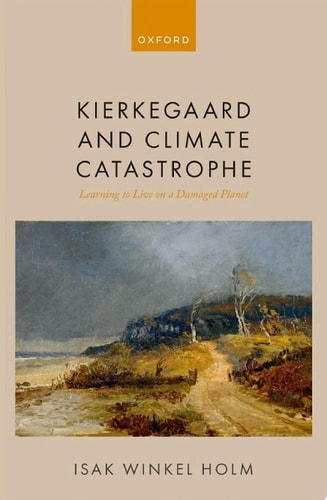
Kierkegaard and Climate Catastrophe: Learning to Live on a Damaged Planet
0
0
As an Amazon Associate and affiliate partner, Menrva Books earns from qualifying purchases. Learn more
Author Description
Søren Kierkegaard's work is teeming with images of earthquakes, floods, storms, volcanic eruptions, wildfires, burned down cities, and apocalyptic events that 'let the heavens fall and the stars change their places in the overturning of everything'. These disaster images are not just rhetorical packaging of the philosophical and theological content of his works. Rather, disasters play an important but largely understudied role in Kierkegaard's analysis of human existence. Kierkegaard and Climate Catastrophe focuses on prophetic noir in Kierkegaard's work: the sombre mood that is evoked when the shadow of future disaster falls upon the present. Isak Winkel Holm's core contention is that the prophetic noir in Kierkegaard, modelled after the prophetic books of the Hebrew Bible, contributes to making his works urgently relevant today. From the vantage point of the contemporary world threatened by rapidly evolving climate catastrophes, Kierkegaard's analysis of human existence emerges in a more sombre light, dimmed by the future disaster: to exist, in the emphatic sense Kierkegaard gave to that word, is to live a meaningful human life even if things are darkened by the coming calamity. Thus, a thorough analysis of the prophetic noir in Kierkegaard offers an existential perspective on living in a world threatened by environmental devastation.
Menrva's Summary
THE THESIS
This book investigates how Søren Kierkegaard’s philosophical and theological engagement with disaster imagery provides a framework for understanding human existence in the face of contemporary climate catastrophe. Isak Winkel Holm, a scholar of literature and culture, utilizes a close reading of Kierkegaard’s texts to identify a recurring 'prophetic noir' mood. He argues that this specific existential perspective, which acknowledges the shadow of future calamity, offers a viable method for maintaining meaningful life within a world currently undergoing environmental degradation.
THE SCOPE MAP
What You Will Find
- Analysis of disaster imagery including earthquakes, floods, and wildfires in Kierkegaard's corpus.
- A conceptual framework defining 'prophetic noir' as a response to impending environmental collapse.
- Comparative studies between Kierkegaardian existentialism and the prophetic traditions of the Hebrew Bible.
Scope Limits
- The text does not provide empirical climate science data or policy recommendations for environmental mitigation.
- It does not attempt to offer a comprehensive biography of Kierkegaard, focusing instead on specific thematic imagery.
THE AUTHORITY PERSPECTIVE
Scholars and readers note that this work provides a unique bridge between 19th-century existential philosophy and modern ecological anxiety. Experts highlight the text as a significant contribution to the field of environmental humanities for its rigorous application of Kierkegaardian thought to contemporary crises.
Page Count:
245
Publication Date:
2022-01-01
Publisher:
OUP Oxford
ISBN-10:
0192676741
ISBN-13:
9780192676740
Religion
Philosophy
Existentialism
Climate Change
Theology
Literary Criticism
Special Topics
Community Tags
Similar Books