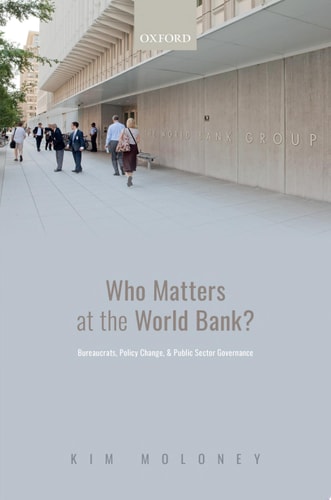
Who Matters at the World Bank?: Bureaucrats, Policy Change, and Public Sector Governance
0
0
As an Amazon Associate and affiliate partner, Menrva Books earns from qualifying purchases. Learn more
Author Description
Who Matters at the World Bank explores "who matters" in a 32-year history (1980-2012) of policy change within the World Bank's public sector management and public sector governance agenda, and is anchored within the public administration discipline and its understanding of bureaucracy, bureaucratic politics, and stakeholder influences. In response to constructivist scholars' concerns about politics and the organizational culture of international civil servants within international organizations, Kim Moloney uses stakeholder theory and a bureaucratic politics approach to suggest the normality of politics, policy debate, and policy evolution. The book also highlights how for 21 of those 32 years it was not external stakeholders but the international civil servants of the World Bank who most influenced, led, developed, and institutionalized this sector's agenda. In so doing, the book explains how one sector of the Bank's work rose, against the odds, from being included in just under 3% of approved projects in 1980 to 73% of all projects approved between 1991 and 2012.
Menrva's Summary
THE THESIS
This book investigates the internal mechanisms of policy evolution within the World Bank to determine which actors exert the most influence over public sector governance agendas. Kim Moloney, a scholar of public administration, utilizes a longitudinal analysis of World Bank projects from 1980 to 2012 to challenge traditional assumptions about external stakeholder influence. By applying stakeholder theory and a bureaucratic politics framework, the author argues that international civil servants, rather than external actors, were the primary drivers of policy institutionalization for the majority of the study period.
THE SCOPE MAP
What You Will Find
- A 32-year historical dataset of World Bank public sector management and governance projects.
- Application of stakeholder theory to international organizational behavior.
- Analysis of bureaucratic politics within international civil service structures.
Scope Limits
- The study is confined to the public sector management and governance agenda and does not address other operational sectors of the Bank.
- The analysis concludes at 2012 and does not account for subsequent organizational shifts.
THE AUTHORITY PERSPECTIVE
Scholars in the field of international organizations identify this work as a rigorous application of public administration theory to the internal culture of the World Bank. Readers frequently note the academic density of the prose and the precision of the author's methodological approach to bureaucratic influence.
Page Count:
368
Publication Date:
2022-10-19
Publisher:
Oxford University Press
ISBN-10:
019285772X
ISBN-13:
9780192857729
Economics
International relations
Governance
Public Administration
Bureaucracy
Community Tags
Similar Books