Consciousness: Essays from a Higher-Order Perspective
0
0
As an Amazon Associate and affiliate partner, Menrva Books earns from qualifying purchases. Learn more
Author Description
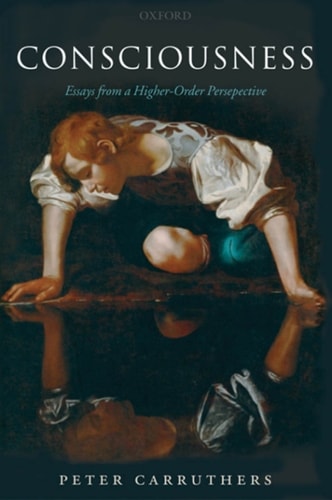
Peter Carruthers's essays on consciousness and related issues have had a substantial impact on the field, and many of his best are now collected here in revised form. The first half of the volume is devoted to developing, elaborating, and defending against competitors one particular sort of reductive explanation of phenomenal consciousness, which Carruthers now refers to as 'dual-content theory'. Phenomenal consciousness - the feel of experience - is supposed to constitute the 'hard problem' for a scientific world view, and many have claimed that it is an irredeemable mystery. But Carruthers here claims to have explained it. He argues that phenomenally conscious states are ones that possess both an 'analog' (fine-grained) intentional content and a corresponding higher-order analog content, representing the first-order content of the experience. It is the higher-order analog content that enables our phenomenally conscious experiences to present themselves to us, and that constitutes their distinctive subjective aspect, or feel. The next two chapters explore some of the differences between conscious experience and conscious thought, and argue for the plausibility of some kind of eliminativism about conscious thinking (while retaining realism about phenomenal consciousness). Then the final four chapters focus on the minds of non-human animals. Carruthers argues that even if the experiences of animals aren't phenomenally conscious (as his account probably implies), this needn't prevent the frustrations and sufferings of animals from being appropriate objects of sympathy and concern. Nor need it mean that there is any sort of radical 'Cartesian divide' between our minds and theirs of deep significance for comparative psychology. In the final chapter, he argues provocatively that even insects have minds that include a belief/desire/perception psychology much like our own. So mindedness and phenomenal consciousness couldn't be further apart. Carruthers's writing throughout
Menrva's Summary
THE THESIS
This collection investigates the nature of phenomenal consciousness and its relationship to higher-order mental states. Peter Carruthers, a prominent philosopher of mind, utilizes a framework of dual-content theory to argue that phenomenal consciousness can be explained through reductive, physicalist terms. By analyzing the distinction between analog intentional content and higher-order representations, he attempts to resolve the 'hard problem' of experience while addressing the cognitive status of non-human animals.
THE SCOPE MAP
What You Will Find
- Dual-content theory of phenomenal consciousness
- Arguments regarding the distinction between conscious experience and conscious thought
- Analysis of animal cognition and the moral status of non-human creatures
- Philosophical arguments for belief-desire-perception psychology in insects
Scope Limits
- The text does not provide a comprehensive survey of all competing theories of consciousness
- It does not focus on neurobiological data, remaining primarily within the realm of analytical philosophy
THE AUTHORITY PERSPECTIVE
Experts recognize this volume as a significant contribution to the higher-order theory of consciousness, noting the rigorous and often provocative nature of Carruthers's arguments. Readers frequently highlight the academic density of the prose, which is best suited for those already familiar with contemporary debates in the philosophy of mind.
Page Count:
264
Publication Date:
2005-01-01
Publisher:
Oxford University Press, U.S.A.
ISBN-10:
0191535044
ISBN-13:
9780191535048
Philosophy
Consciousness Studies
Mind & Body
Philosophy of
Community Tags
Similar Books