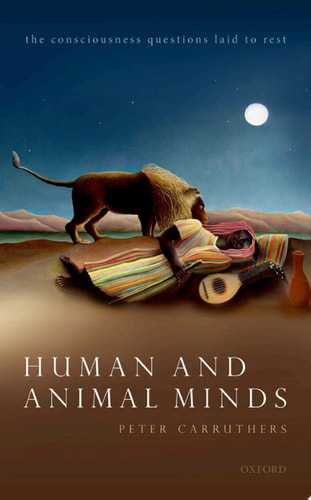
Human and Animal Minds: The Consciousness Questions Laid to Rest
0
0
As an Amazon Associate and affiliate partner, Menrva Books earns from qualifying purchases. Learn more
Author Description
The continuities between human and animal minds are increasingly well understood. This has led many people to make claims about consciousness in animals, which has often been taken to be crucial for their moral standing. Peter Carruthers argues compellingly that there is no fact of the matter to be discovered, and that the question of animal consciousness is of no scientific or ethical significance. Carruthers offers solutions to two related puzzles. The first is about the place of phenomenal--or felt--consciousness in the natural order. Consciousness is shown to comprise fine-grained nonconceptual contents that are "globally broadcast" to a wide range of cognitive systems for reasoning, decision-making, and verbal report. Moreover, the so-called "hard" problem of consciousness results merely from the distinctive first-person concepts we can use when thinking about such contents. No special non-physical properties--no so-called "qualia"--are involved. The second puzzle concerns the distribution of phenomenal consciousness across the animal kingdom. Carruthers shows that there is actually no fact of the matter, because thoughts about consciousness in other creatures require us to project our first-person concepts into their minds; but such projections fail to result in determinate truth-conditions when those minds are significantly unlike our own. This upshot, however, doesn't matter. It doesn't matter for science, because no additional property enters the world as one transitions from creatures that are definitely incapable of phenomenal consciousness to those that definitely are (namely, ourselves). And on many views it doesn't matter for ethics, either, since concern for animals can be grounded in sympathy, which requires only third-person understanding of the desires and emotions of the animals in question, rather than in first-person empathy.
Menrva's Summary
THE THESIS
Peter Carruthers investigates whether animal consciousness exists as a scientifically or ethically significant phenomenon, ultimately arguing that the question lacks a factual basis. Drawing on his background in philosophy and cognitive science, Carruthers posits that phenomenal consciousness is a result of globally broadcast nonconceptual content rather than non-physical properties. He contends that the difficulty of the 'hard problem' of consciousness arises from the limitations of first-person conceptualization, which fails when applied to non-human minds.
THE SCOPE MAP
What You Will Find
- A functionalist theory of consciousness based on global broadcasting
- An analysis of the 'hard problem' of consciousness and the nature of qualia
- A philosophical argument regarding the indeterminacy of attributing consciousness to non-human animals
Scope Limits
- Does not provide an empirical biological survey of specific animal nervous systems
- Does not offer a comprehensive ethical framework for animal rights beyond the critique of consciousness-based arguments
THE AUTHORITY PERSPECTIVE
Scholars in the philosophy of mind frequently note the provocative nature of Carruthers's claims regarding the irrelevance of animal consciousness to ethical standing. The text is recognized as a rigorous, albeit controversial, contribution to the ongoing debate between functionalist and phenomenological approaches to cognitive science.
Page Count:
232
Publication Date:
2019-01-01
Publisher:
OUP Oxford
ISBN-10:
0192581813
ISBN-13:
9780192581815
Philosophy
Animal Welfare
Consciousness Studies
Zoology
Human Relationships
Animal Ethics
Consciousness in animals
Mind & Body
Sympathy
Philosophy of
Community Tags
Similar Books