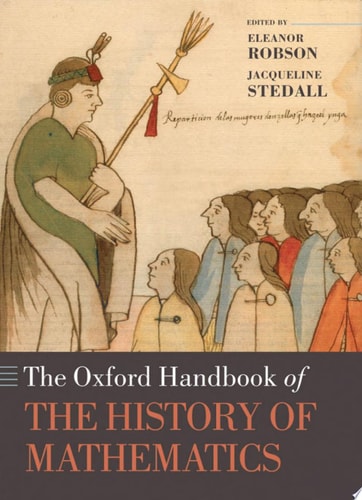
The Oxford Handbook of the History of Mathematics
0
0
As an Amazon Associate and affiliate partner, Menrva Books earns from qualifying purchases. Learn more
Author Description
This Handbook explores the history of mathematics under a series of themes which raise new questions about what mathematics has been and what it has meant to practise it. It addresses questions of who creates mathematics, who uses it, and how. A broader understanding of mathematical practitioners naturally leads to a new appreciation of what counts as a historical source. Material and oral evidence is drawn upon as well as an unusual array of textual sources. Further, the ways in which people have chosen to express themselves are as historically meaningful as the contents of the mathematics they have produced. Mathematics is not a fixed and unchanging entity. New questions, contexts, and applications all influence what counts as productive ways of thinking. Because the history of mathematics should interact constructively with other ways of studying the past, the contributors to this book come from a diverse range of intellectual backgrounds in anthropology, archaeology, art history, philosophy, and literature, as well as history of mathematics more traditionally understood. The thirty-six self-contained, multifaceted chapters, each written by a specialist, are arranged under three main headings: 'geographies and cultures', 'peoples and practices', and 'interactions and interpretations'. Together they deal with the mathematics of 5000 years, but without privileging the past three centuries, and an impressive range of periods and places with many points of cross-reference between chapters. The key mathematical cultures of North America, Europe, the Middle East, India, and China are all represented here as well as areas which are not often treated in mainstream history of mathematics, such as Russia, the Balkans, Vietnam, and South America. A vital reference for graduates and researchers in mathematics, historians of science, and general historians.
Menrva's Summary
THE THESIS
This volume investigates the evolution of mathematical practice by questioning traditional historiographical boundaries and examining the diverse cultural contexts in which mathematics has been created and utilized over 5,000 years. Editors Eleanor Robson and Jacqueline A. Stedall curate a collection of thirty-six chapters written by specialists from interdisciplinary backgrounds, including anthropology, archaeology, and philosophy. The text argues that mathematics is not a static entity but a dynamic human activity shaped by its practitioners, their tools, and their specific historical environments.
THE SCOPE MAP
What You Will Find
- A thematic organization covering Geographies and Cultures, Peoples and Practices, and Interactions and Interpretations.
- Analysis of mathematical traditions across North America, Europe, the Middle East, India, China, Russia, the Balkans, Vietnam, and South America.
- Integration of non-textual evidence, including oral traditions and material culture, alongside traditional mathematical manuscripts.
Scope Limits
- The text does not provide a linear, chronological narrative of mathematical discovery.
- It avoids privileging the developments of the past three centuries over earlier historical periods.
THE AUTHORITY PERSPECTIVE
Experts recognize this handbook as a significant contribution to the field for its departure from Eurocentric and purely technical histories of mathematics. Scholars and researchers frequently cite the text as a foundational resource for understanding the intersection of mathematical practice with broader cultural and historical studies.
Page Count:
926
Publication Date:
2008-01-01
Publisher:
Oup Oxford
ISBN-10:
0191549959
ISBN-13:
9780191549953
Historiography
Mathematics
Academic
Reference
Science History
Community Tags
Other Editions(2)
Similar Books





Reader Comments
Share Your Thoughts
No comments yet. Be the first to share your thoughts!