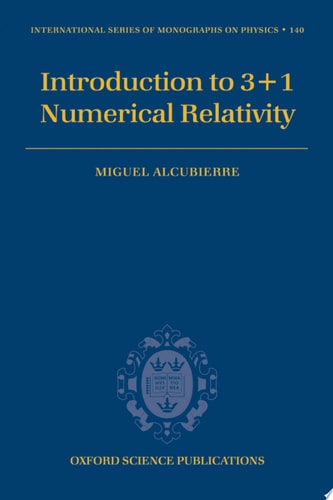
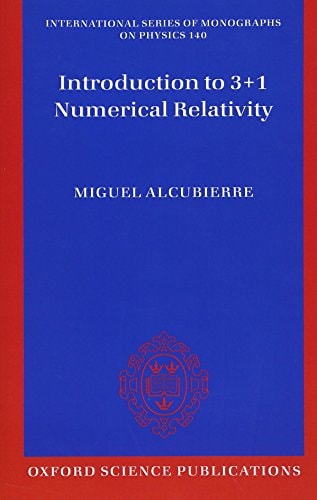
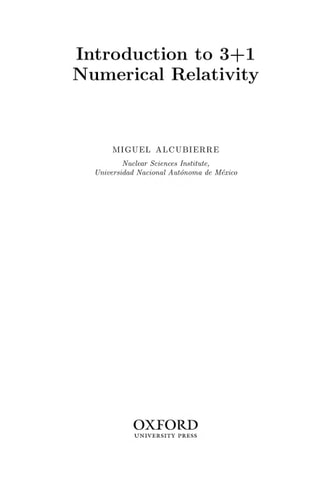
Introduction to 3+1 Numerical Relativity
0
0
As an Amazon Associate and affiliate partner, Menrva Books earns from qualifying purchases. Learn more
Author Description
This book introduces the modern field of 3+1 numerical relativity. The book has been written in a way as to be as self-contained as possible, and only assumes a basic knowledge of special relativity. Starting from a brief introduction to general relativity, it discusses the different concepts and tools necessary for the fully consistent numerical simulation of relativistic astrophysical systems, with strong and dynamical gravitational fields. Among the topics discussed in detail are the following: the initial data problem, hyperbolic reductions of the field equations, gauge conditions, the evolution of black hole space-times, relativistic hydrodynamics, gravitational wave extraction and numerical methods. There is also a final chapter with examples of some simple numerical space-times. The book is aimed at both graduate students and researchers in physics and astrophysics, and at those interested in relativistic astrophysics.
Menrva's Summary
THE THESIS
This text investigates the mathematical and computational frameworks required to perform numerical simulations of relativistic astrophysical systems within the 3+1 decomposition of spacetime. Miguel Alcubierre, a physicist specializing in numerical relativity, provides a structured pedagogical approach that bridges the gap between theoretical general relativity and practical computational implementation. The book establishes the necessary formalism for evolving gravitational fields, assuming only foundational knowledge of special relativity to ensure accessibility for graduate-level students and researchers.
THE SCOPE MAP
What You Will Find
- The 3+1 decomposition of Einstein's field equations
- Hyperbolic reduction methods for field equations
- Gauge condition selection and initial data problem solutions
- Relativistic hydrodynamics and gravitational wave extraction techniques
- Numerical methods for black hole spacetime evolution
Scope Limits
- Does not provide an exhaustive survey of all alternative gravity theories
- Does not include pre-written software or source code for immediate simulation
THE AUTHORITY PERSPECTIVE
Experts frequently cite this work as a foundational text for those entering the field of numerical relativity due to its clear, self-contained derivation of complex equations. Readers often note the academic density of the prose, which requires a solid grasp of tensor calculus to fully appreciate the technical nuances presented.
Page Count:
464
Publication Date:
2008-01-01
Publisher:
OUP Oxford
ISBN-10:
0191548294
ISBN-13:
9780191548291
Science
Mathematics
Astrophysics
Earth Sciences
General Relativity
Mathematical Physics
Physics
Community Tags
Other Editions(4)

Similar Books