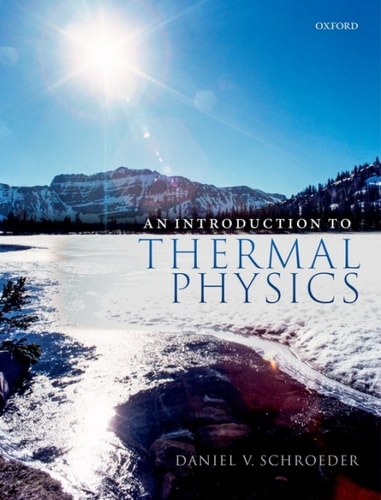
An Introduction to Thermal Physics
0
0
As an Amazon Associate and affiliate partner, Menrva Books earns from qualifying purchases. Learn more
Author Description
Thermal physics deals with collections of large numbers of particles - typically 10 to the 23rd power or so. Examples include the air in a balloon, the water in a lake, the electrons in a chunk of metal, and the photons given off by the sun. We can't possibly follow every detail of the motions of so many particles. So in thermal physics we assume that these motions are random, and we use the laws of probability to predict how the material as a whole ought to behave. Alternatively, we can measure the bulk properties of a material, and from these infer something about the particles it is made of. This book will give you a working understanding of thermal physics, assuming that you have already studied introductory physics and calculus. You will learn to apply the general laws of energy and entropy to engines, refrigerators, chemical reactions, phase transformations, and mixtures. You will also learn to use basic quantum physics and powerful statistical methods to predict in detail how temperature affects molecular speeds, vibrations of solids, electrical and magnetic behaviors, emission of light, and exotic low-temperature phenomena. The problems and worked examples explore applications not just within physics but also to engineering, chemistry, biology, geology, atmospheric science, astrophysics, cosmology, and everyday life.
Menrva's Summary
THE THESIS
How can the macroscopic behavior of large particle systems be predicted using the laws of probability and statistical mechanics? Daniel V. Schroeder provides a comprehensive framework for understanding thermal physics by bridging the gap between microscopic particle motion and bulk material properties. The text assumes a foundational knowledge of introductory physics and calculus, utilizing these tools to derive the laws of energy and entropy. By applying statistical methods to diverse systems, the author demonstrates how temperature influences physical phenomena across multiple scientific disciplines.
THE SCOPE MAP
What You Will Find
- Statistical mechanics and the application of probability to particle systems
- Thermodynamic laws applied to engines, refrigerators, and chemical reactions
- Quantum physics principles as they relate to molecular speeds and solid vibrations
- Interdisciplinary applications in engineering, biology, geology, and astrophysics
Scope Limits
- Requires prior completion of introductory physics and calculus coursework
- Does not provide an exhaustive treatment of advanced relativistic thermodynamics
THE AUTHORITY PERSPECTIVE
Experts and educators frequently cite this text as a standard undergraduate resource for its clear, pedagogical approach to complex statistical concepts. Readers often note that the balance between theoretical derivation and practical, real-world problem sets makes the material highly accessible for physics and engineering students.
Page Count:
448
Publication Date:
2020-01-01
Publisher:
OUP Oxford
ISBN-10:
0192648101
ISBN-13:
9780192648105
Science
Thermodynamics
Statistical mechanics
Mathematical Physics
Earth Sciences
Physics
textbook
Community Tags
Other Editions(4)


Similar Books