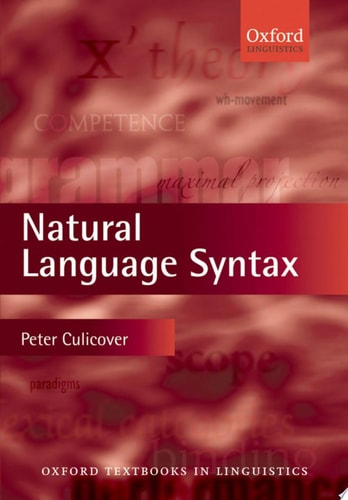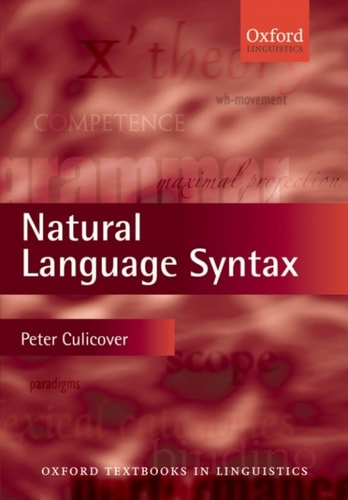
Natural Language Syntax
0
0
As an Amazon Associate and affiliate partner, Menrva Books earns from qualifying purchases. Learn more
Author Description
In this book, Peter Culicover introduces the analysis of natural language within the broader question of how language works - of how people use languages to configure words and morphemes in order to express meanings. He focuses both on the syntactic and morphosyntactic devices that languages use, and on the conceptual structures that correspond to particular aspects of linguistic form. He seeks to explain linguistic forms and in the process to show how these correspond with meanings. The book's clear, step-by-step exposition is presented within the Simpler Syntax framework whose development has been led by the author and Ray Jackendoff over the last fifteen years. This integrates syntactic theory with the representation of conceptual structure and casts fresh light on the interface between syntax and semantics. It also enables elegant and economical analyses of natural language phenomena without recourse to such abstract devices as functional heads and uniform binary branching. Peter Culicover opens his account with an overview of the nature of language and the aims of its analysis. He then divides the book into parts devoted to syntactic categories, syntactic structure and argument structure, argument realization, unbounded dependencies, and clausal structure. He provides exercises, problems, and suggestions for further reading throughout the book.
Menrva's Summary
THE THESIS
How do the structural configurations of words and morphemes in natural language map onto the expression of human meaning? Peter W. Culicover, a prominent linguist, utilizes the Simpler Syntax framework to argue that linguistic form can be explained through a direct integration of syntactic theory and conceptual structure, avoiding the need for highly abstract theoretical constructs.
THE SCOPE MAP
What You Will Find
- Analysis of syntactic categories and argument structure
- Examination of argument realization and unbounded dependencies
- Application of the Simpler Syntax framework developed by Culicover and Ray Jackendoff
- Pedagogical tools including exercises, problem sets, and reading suggestions
Scope Limits
- Does not utilize traditional generative grammar devices such as functional heads or uniform binary branching
- Focuses primarily on the interface between syntax and semantics rather than phonology or historical linguistics
THE AUTHORITY PERSPECTIVE
Linguists and students frequently cite this text as a primary resource for understanding the Simpler Syntax approach to linguistic analysis. The work is recognized for its clear, step-by-step exposition, making it a standard reference for those exploring alternatives to mainstream generative syntactic models.
Page Count:
352
Publication Date:
2009-01-01
Publisher:
OUP Oxford
ISBN-10:
0191552100
ISBN-13:
9780191552106
English & College Success
Syntax
Linguistics
English
textbook
Grammar
Academic
Semantics