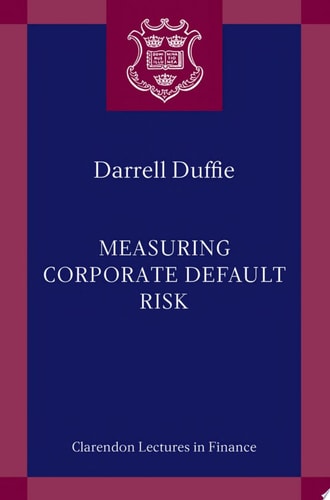
Measuring Corporate Default Risk
0
0
As an Amazon Associate and affiliate partner, Menrva Books earns from qualifying purchases. Learn more
Author Description
This Book, Based On The Author's Clarendon Lectures In Finance, Examines The Empirical Behaviour Of Corporate Default Risk. A New And Unified Statistical Methodology For Default Prediction, Based On Stochastic Intensity Modeling, Is Explained And Implemented With Data On U.s. Public Corporations Since 1980. Special Attention Is Given To The Measurement Of Correlation Of Default Risk Across Firms. The Underlying Work Was Developed In A Series Of Collaborations Over Roughly The Past Decade With Sanjiv Das, Andreas Eckner, Guillaume Horel, Nikunj Kapadia, Leandro Saita, And Ke Wang. Where Possible, The Content Based On Methodology Has Been Separated From The Substantive Empirical Findings, In Order To Provide Access To The Latter For Those Less Focused On The Mathematical Foundations. A Key Finding Is That Corporate Defaults Are More Clustered In Time Than Would Be Suggested By Their Exposure To Observable Common Or Correlated Risk Factors. The Methodology Allows For Hidden Sources Of Default Correlation, Which Are Particularly Important To Include When Estimating The Likelihood That A Portfolio Of Corporate Loans Will Suffer Large Default Losses. The Data Also Reveal That A Substantial Amount Of Power For Predicting The Default Of A Corporation Can Be Obtained From The Firm's Distance To Default, A Volatility-adjusted Measure Of Leverage That Is The Basis Of The Theoretical Models Of Corporate Debt Pricing Of Black, Scholes, And Merton. The Findings Are Particularly Relevant In The Aftermath Of The Financial Crisis, Which Revealed A Lack Of Attention To The Proper Modelling Of Correlation Of Default Risk Across Firms.
Menrva's Summary
THE THESIS
This book investigates the empirical behavior of corporate default risk and proposes a unified statistical methodology for predicting defaults. Darrell Duffie, a professor at Stanford University, utilizes decades of collaborative research and empirical data from U.S. public corporations since 1980 to construct his framework. The text argues that corporate defaults exhibit significant temporal clustering that exceeds what is explained by observable risk factors alone, necessitating more robust modeling of hidden default correlations.
THE SCOPE MAP
What You Will Find
- Stochastic intensity modeling for default prediction
- Analysis of U.S. public corporation data from 1980 to the present
- Measurement techniques for default risk correlation across firms
- Application of the distance to default metric based on Black-Scholes-Merton models
Scope Limits
- The text assumes a baseline familiarity with financial mathematics and statistical modeling
- It does not provide a general history of corporate debt markets outside the context of default risk measurement
THE AUTHORITY PERSPECTIVE
Experts recognize this work as a foundational text for understanding the complexities of credit risk and default correlation in modern financial markets. Readers frequently note the technical density of the prose, which is balanced by the author's effort to separate mathematical methodology from empirical findings for broader accessibility.
Page Count:
128
Publication Date:
2011-01-01
Publisher:
Oxford University Press
ISBN-10:
0191557455
ISBN-13:
9780191557453
Economics
Finance
Corporate Finance
Statistics
Community Tags
Other Editions(3)
Similar Books









Reader Comments
Share Your Thoughts
No comments yet. Be the first to share your thoughts!