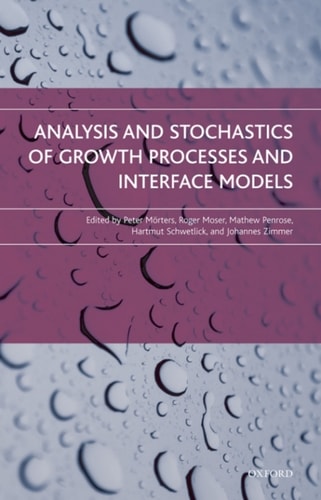
Analysis and Stochastics of Growth Processes and Interface Models
0
0
As an Amazon Associate and affiliate partner, Menrva Books earns from qualifying purchases. Learn more
Author Description
This book is a collection of topical survey articles by leading researchers in the fields of applied analysis and probability theory, working on the mathematical description of growth phenomena. Particular emphasis is on the interplay of the two fields, with articles by analysts being accessible for researchers in probability, and vice versa. Mathematical methods discussed in the book comprise large deviation theory, lace expansion, harmonic multi-scale techniques and homogenisation of partial differential equations. Models based on the physics of individual particles are discussed alongside models based on the continuum description of large collections of particles, and the mathematical theories are used to describe physical phenomena such as droplet formation, Bose-Einstein condensation, Anderson localization, Ostwald ripening, or the formation of the early universe. The combination of articles from the two fields of analysis and probability is highly unusual and makes this book an important resource for researchers working in all areas close to the interface of these fields.
Menrva's Summary
THE THESIS
This book investigates the mathematical intersection of applied analysis and probability theory as they relate to the modeling of growth processes and interface phenomena. The authors, Mathew D. Penrose, Peter Mörters, and Roger Moser, curate a collection of survey articles from leading researchers to bridge the gap between discrete particle-based models and continuum descriptions. The text provides a rigorous framework for understanding complex physical systems through advanced mathematical techniques.
THE SCOPE MAP
What You Will Find
- Large deviation theory and lace expansion methodologies
- Harmonic multi-scale techniques and homogenisation of partial differential equations
- Mathematical descriptions of droplet formation, Bose-Einstein condensation, and Anderson localization
Scope Limits
- The text does not provide an introductory overview for undergraduate students lacking a background in advanced analysis or probability
- It does not cover experimental physics data, focusing exclusively on theoretical and mathematical modeling
THE AUTHORITY PERSPECTIVE
Experts identify this collection as a specialized resource for researchers operating at the intersection of analysis and probability. Readers frequently note the high level of mathematical density and the technical rigor required to engage with the provided survey articles.
Page Count:
308
Publication Date:
2008-01-01
Publisher:
OUP Oxford
ISBN-10:
019155359X
ISBN-13:
9780191553592
Mathematics Statistics
Stochastic processes
Probability
Applied Analysis
Mathematics - General
Probability Theory
Mathematical Physics
Mathematics
Community Tags
Similar Books