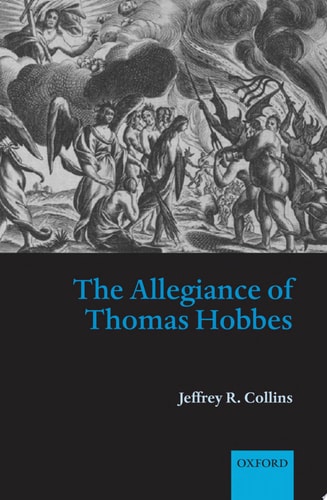
The Allegiance of Thomas Hobbes
0
0
As an Amazon Associate and affiliate partner, Menrva Books earns from qualifying purchases. Learn more
Author Description
The Allegiance of Thomas Hobbes offers a revisionist interpretation of Thomas Hobbes's evolving response to the English Revolution. It rejects the prevailing understanding of Hobbes as a consistent, if idiosyncratic, royalist, and vindicates the contemporaneous view that the publication of Leviathan marked Hobbes's accommodation with England's revolutionary regime. In sustaining these conclusions, Professor Collins foregrounds the religious features of Hobbes's writings, and maintains a contextual focus on the broader religious dynamics of the English Revolution itself. Hobbes and the Revolution are both placed within the tumultuous historical process that saw the emerging English state coercively secure jurisdictional control over national religion and the corporate church. Seen in the light of this history, Thomas Hobbes emerges as a theorist who moved with, rather than against, the revolutionary currents of his age. The strongest claim of the book is that Hobbes was motivated by his deep detestation of clerical power to break with the Stuart cause and to justify the religious policies of England's post-regicidal masters, including Oliver Cromwell. Methodologically, Professor Collins supplements intellectual or linguistic contextual analysis with original research into Hobbes's biography, the prosopography of his associates, the reception of Hobbes's published works, and the nature of the English Revolution as a religious conflict. This multi-dimensional contextual approach produces, among other fruits: a new understanding of the political implications of Leviathan; an original interpretation of Hobbes's civil war history, Behemoth; a clearer picture of Hobbes's career during the neglected period of the 1650s; and a revisionist interpretation of Hobbes's reaction to the emergence of English republicanism. By presenting Thomas Hobbes as a political actor within a precisely defined political context, Professor Collins has recovered the significance of Hobbes's writing.
Menrva's Summary
THE THESIS
This work investigates whether Thomas Hobbes was a consistent royalist or a pragmatic actor who aligned himself with the revolutionary regime of the English Civil War. Professor Jeffrey R. Collins, a scholar of early modern political thought, utilizes a combination of biographical research, prosopography, and contextual analysis to challenge the traditional view of Hobbes. He argues that Hobbes’s primary motivation was a profound opposition to clerical power, which led him to support the religious policies of the post-regicidal government under Oliver Cromwell.
THE SCOPE MAP
What You Will Find
- Analysis of the political and religious climate of the 1650s in England.
- A re-examination of the primary texts Leviathan and Behemoth.
- Biographical research regarding Hobbes’s associates and the reception of his work.
- A methodology blending intellectual history with political context.
Scope Limits
- The book does not provide a comprehensive biography of Hobbes’s entire life, focusing primarily on his response to the English Revolution.
- It does not offer a general introduction to Hobbesian philosophy for those unfamiliar with his core political theories.
THE AUTHORITY PERSPECTIVE
Scholars in the field of political theory and seventeenth-century history recognize this text as a significant revisionist contribution to Hobbesian studies. Readers frequently note the academic density of the prose and the rigorous historical research that supports the author's claims regarding Hobbes's political allegiances.
Page Count:
326
Publication Date:
2005-01-01
Publisher:
OUP Oxford
ISBN-10:
0191556297
ISBN-13:
9780191556296
History
Biography
European History
Early Modern
Intellectual History
Political Philosophy
Civil War
Community Tags
Other Editions(3)

Similar Books


Reader Comments
Share Your Thoughts
No comments yet. Be the first to share your thoughts!