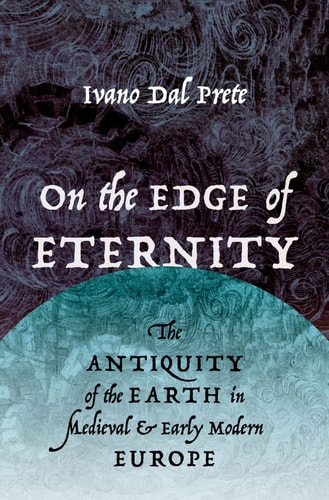
On the Edge of Eternity: The Antiquity of the Earth in Medieval and Early Modern Europe
0
0
As an Amazon Associate and affiliate partner, Menrva Books earns from qualifying purchases. Learn more
Author Description
It is commonly assumed that the creation story of Genesis and its chronology were the only narratives openly available in medieval and early modern Europe and that the discovery of geological time in the eighteenth century came as a momentous breakthrough that shook the faith in the historical accuracy of the Bible. Historians of science, mainstream geologists, and Young Earth creationists alike all share the assumption that the notion of an ancient Earth was highly heterodox in the pre-modern era. The old age of the world is regarded as the offspring of a secularized science.In this book, Ivano Dal Prete radically revises the commonplace history of deep time in Western culture. He argues that the chronology of the Bible always coexisted with alternative approaches that placed the origin of the Earth into a far, undetermined (or even eternal) past. From the late Middle Ages, these notions spread freely not only in universities and among the learned, but even in popular works of meteorology, geology, literature, and art that made them easily accessible to a vernacular and scientifically illiterate public. Religious authorities did not regard these notions as particularly problematic, let alone heretical. Neither the authors nor their numerous readers thought that holding such views was incompatible with their Christian faith. While the appeal of theories centered on the biblical Flood and on a young Earth gained popularity over the course of the seventeenth century, their more secular alternatives remained vital and debated. Enlightenment thinkers, however, created a myth of a Christian tradition that uniformly rejected the antiquity of the world, as opposed to a new secular science ready to welcome it. Largely unchallenged for almost three centuries, that account solidified over time into a still dominant truism. Based on a wealth of mostly unexplored sources, On the Edge of Eternity offers an original and nuanced account of the history of deep time that illuminates
Menrva's Summary
THE THESIS
This work investigates the historical accuracy of the assumption that pre-modern European culture uniformly adhered to a young Earth chronology dictated by Genesis. Ivano Dal Prete, a historian of science, challenges the narrative that the concept of deep time originated solely as a product of eighteenth-century secular science. By analyzing a wide array of previously unexplored primary sources, he argues that alternative, ancient, or eternal models of Earth's history were widely accessible and accepted by both scholars and the general public throughout the late Middle Ages and the early modern period.
THE SCOPE MAP
What You Will Find
- Analysis of medieval and early modern texts in meteorology, geology, literature, and art.
- Evidence of the coexistence of biblical chronology with theories of an ancient or eternal Earth.
- Examination of the intellectual shift during the Enlightenment that constructed the myth of a monolithic Christian rejection of deep time.
Scope Limits
- The study focuses primarily on Western European intellectual history and does not provide an exhaustive global survey of geological thought.
- It does not attempt to validate the scientific accuracy of pre-modern geological theories, but rather their cultural and religious reception.
THE AUTHORITY PERSPECTIVE
Scholars in the history of science recognize this text as a significant revisionist contribution that complicates the traditional conflict model between religion and geology. Readers frequently note the meticulous archival research and the clarity with which the author dismantles long-standing historiographical myths.
Page Count:
366
Publication Date:
2022-01-01
Publisher:
Oxford University Press
ISBN-10:
0190678917
ISBN-13:
9780190678913
Religion
History
Renaissance
Earth Sciences
Intellectual History
Geology
Religion and Science
European History
Science
Science History
History of the Americas
Early Modern
Community Tags
Similar Books