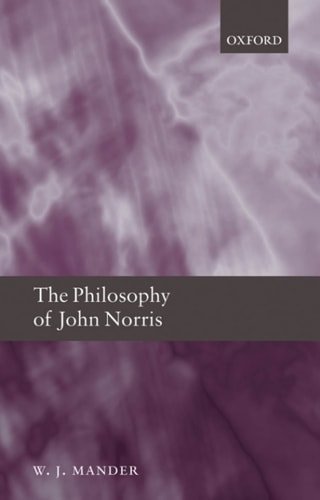
The Philosophy of John Norris
0
0
As an Amazon Associate and affiliate partner, Menrva Books earns from qualifying purchases. Learn more
Author Description
Best known today as one of the earliest critics of John Locke, John Norris (1657-1711) incorporated ideas of Augustine, Malebranche, Plato, the Cambridge Platonists, and the scholastics into an original synthesis that was highly influential on the philosophy and theology of his day. W. J. Mander presents a much-needed study of this unjustly neglected thinker, and the different perspectives he offers on this seminal period in philosophical history.
Menrva's Summary
THE THESIS
This book investigates the philosophical and theological framework of John Norris to determine his significance within the intellectual landscape of the late 17th century. W. J. Mander, a scholar of British philosophy, utilizes primary texts and historical context to reconstruct Norris's unique synthesis of Augustinian, Platonic, and Cartesian ideas. The work argues that Norris occupies a critical position as both a bridge between continental rationalism and British empiricism and as a primary antagonist to the burgeoning Lockean tradition.
THE SCOPE MAP
What You Will Find
- Analysis of Norris's critique of John Locke's empiricism
- Examination of the influence of Malebranche and the Cambridge Platonists
- Synthesis of scholastic and modern philosophical traditions
- Contextualization of Norris's theological contributions
Scope Limits
- Does not provide a comprehensive biography of Norris's personal life
- Does not focus on the broader political history of the era beyond its philosophical implications
THE AUTHORITY PERSPECTIVE
Scholars recognize this text as a necessary intervention in the study of neglected early modern thinkers. Readers frequently note the academic density of the prose, which is intended for those with a background in philosophical history.
Page Count:
208
Publication Date:
2008-01-01
Publisher:
Oxford University Press
ISBN-10:
019155216X
ISBN-13:
9780191552168
Philosophy
Philosophy history
17th Century
Philosophy British
Great Britain
Academic
Theology
History & Surveys