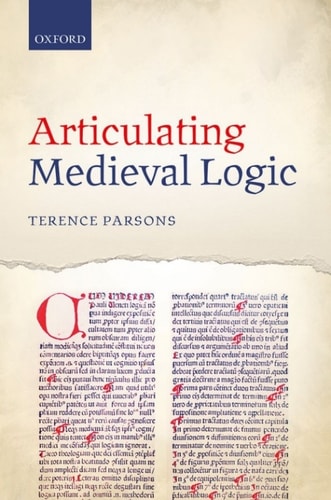
Articulating Medieval Logic
0
0
As an Amazon Associate and affiliate partner, Menrva Books earns from qualifying purchases. Learn more
Author Description
Terence Parsons presents a new study of the development and logical complexity of medieval logic. Basic principles of logic were used by Aristotle to prove conversion principles and reduce syllogisms. Medieval logicians expanded Aristotle's notation in several ways, such as quantifying predicate terms, as in 'No donkey is every animal', and allowing singular terms to appear in predicate position, as in 'Not every donkey is Brownie'; with the enlarged notation come additional logical principles. The resulting system of logic is able to deal with relational expressions, as in De Morgan's puzzles about heads of horses. A crucial issue is a mechanism for dealing with anaphoric pronouns, as in 'Every woman loves her mother'. Parsons illuminates the ways in which medieval logic is as rich as contemporary first-order symbolic logic, though its full potential was not envisaged at the time. Along the way, he provides a detailed exposition and examination of the theory of modes of common personal supposition, and the useful principles of logic included with it. An appendix discusses the artificial signs introduced in the fifteenth century to alter quantifier scope.
Menrva's Summary
THE THESIS
This book investigates the logical complexity and structural development of medieval logic, arguing that it possesses a sophistication comparable to contemporary first-order symbolic logic. Terence Parsons, a scholar of logic and philosophy, utilizes historical texts to demonstrate how medieval thinkers expanded Aristotelian notation to address complex linguistic and logical problems. The work provides a rigorous examination of how these historical systems managed relational expressions and anaphoric pronouns through the theory of modes of common personal supposition.
THE SCOPE MAP
What You Will Find
- Analysis of medieval expansions to Aristotelian syllogistic notation
- Exposition of the theory of modes of common personal supposition
- Examination of logical mechanisms for handling relational expressions and anaphoric pronouns
- Discussion of fifteenth-century artificial signs for quantifier scope
Scope Limits
- The text does not provide a comprehensive history of all medieval philosophical schools
- It does not focus on the theological implications of these logical systems
THE AUTHORITY PERSPECTIVE
Scholars and students of formal logic frequently cite this work for its clear translation of medieval concepts into modern symbolic notation. Experts highlight the text as a rigorous resource for understanding the technical depth of pre-modern logical systems.
Page Count:
331
Publication Date:
2014-01-01
Publisher:
OUP Oxford
ISBN-10:
0191002658
ISBN-13:
9780191002656
Philosophy
Philosophy history
Logic
History & Surveys
Academic
Logic Medieval
Community Tags
Other Editions(3)

Similar Books