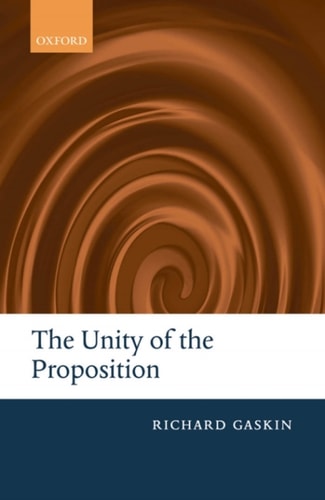
The Unity of the Proposition
0
0
As an Amazon Associate and affiliate partner, Menrva Books earns from qualifying purchases. Learn more
Author Description
Richard Gaskin presents a work in the philosophy of language. He analyses what is distinctive about sentences and the propositions they express--what marks them off from mere lists of words and mere aggregates of word-meanings respectively. Since he identifies the world with all the true and false propositions, his account of the unity of the proposition has significant implications for our understanding of the nature of reality. He argues that the unity of the proposition is constituted by a certain infinitistic structure known in the tradition as 'Bradley's regress'. Usually, Bradley's regress has been regarded as vicious, but Gaskin argues that it is the metaphysical ground of the propositional unity, and gives us an important insight into the fundamental make-up of the world.
Menrva's Summary
THE THESIS
This work investigates the fundamental nature of propositional unity and its implications for the structure of reality. Richard Gaskin, a scholar in the philosophy of language, examines the distinction between coherent propositions and mere aggregates of words. By identifying the world with the totality of true and false propositions, he posits that the unity of a proposition is grounded in an infinitistic structure traditionally identified as Bradley's regress, which he reinterprets as a constructive metaphysical principle rather than a logical failure.
THE SCOPE MAP
What You Will Find
- Analysis of the distinction between linguistic lists and meaningful propositions
- A re-evaluation of Bradley's regress as a metaphysical foundation
- Theoretical framework linking propositional structure to the nature of reality
Scope Limits
- Does not provide a general introduction to philosophy of language
- Does not address empirical or scientific data regarding cognitive linguistics
THE AUTHORITY PERSPECTIVE
Experts in analytic philosophy recognize this text as a rigorous, highly specialized contribution to the study of propositional unity. Readers frequently note the academic density of the prose, which requires a strong background in metaphysical logic to fully comprehend.
Page Count:
128
Publication Date:
2008-01-01
Publisher:
Oxford University Press
ISBN-10:
019155362X
ISBN-13:
9780191553622
Philosophy
Philosophy of
Logic
Metaphysics
Community Tags
Similar Books