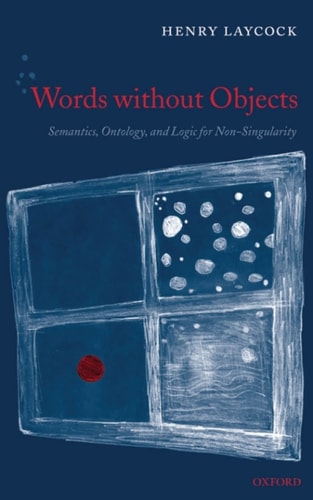
Words without Objects: Semantics, Ontology, and Logic for Non-Singularity
0
0
As an Amazon Associate and affiliate partner, Menrva Books earns from qualifying purchases. Learn more
Author Description
A picture of the world as chiefly one of discrete objects, distributed in space and time, has sometimes seemed compelling. It is however one of two main targets of Henry Laycock's book; for it is seriously incomplete. The picture, he argues, leaves no space for stuff like air and water. With discrete objects, we may always ask 'how many?', but with stuff the question has to be 'how much?' Within philosophy, stuff of certain basic kinds is central to the ancient pre-Socratic world-view; but it also constitutes the field of modern chemistry and is a major factor in ecology. Philosophers these days, in general, are unlikely to deny that stuff exists. But they are very likely to deny that it is ('ultimately') to be contrasted with things, and it is on this account that logic and semantics figure largely in the framework of the book. Elementary logic is a logic which takes values for its variables; and these values are precisely distinct individuals or things. Existence is then symbolized in just such terms; and this, it is proposed, creates a pressure for 'reducing' stuff to things. Non-singular expressions, which include words for stuff, 'mass' nouns, and also plural nouns, are 'explicated' as semantically singular. Here then is the second target of the book. The posit that both mass and plural nouns name special categories of objects (set-theoretical 'collections' of objects in the one case, mereological 'parcels' or 'portions' of stuff in the other) represents, so Laycock urges, the imposition of an alien logic upon both the many and the much.
Menrva's Summary
THE THESIS
This work investigates whether the prevailing philosophical reliance on discrete objects as the primary constituents of reality is fundamentally incomplete due to its inability to account for mass nouns and non-singular entities. Henry Laycock, a philosopher specializing in the intersection of logic and ontology, challenges the reductionist tendency to treat all existence as singular individuals. He argues that current logical frameworks, which prioritize discrete variables, impose an artificial structure on the world that fails to accommodate the nature of 'stuff' like air or water.
THE SCOPE MAP
What You Will Find
- A critique of standard predicate logic and its reliance on singular variables.
- An analysis of the semantic differences between mass nouns and count nouns.
- A philosophical examination of pre-Socratic, chemical, and ecological perspectives on matter.
Scope Limits
- The text does not provide a comprehensive history of mereology beyond its relevance to the author's specific argument.
- It does not offer a practical guide for scientific application, focusing instead on the formal logical and ontological implications.
THE AUTHORITY PERSPECTIVE
Scholars in the field of analytic philosophy recognize this text as a rigorous challenge to standard mereological and semantic assumptions regarding mass nouns. Readers frequently note the high level of technical density in the prose, which requires a strong background in formal logic to fully navigate the author's arguments.
Page Count:
224
Publication Date:
2006-01-01
Publisher:
Oxford University Press
ISBN-10:
0191535915
ISBN-13:
9780191535918
Philosophy
Logic
Philosophy of
Semantics
Substance philosophy
Metaphysics
Ontology
Community Tags
Other Editions(2)
Similar Books