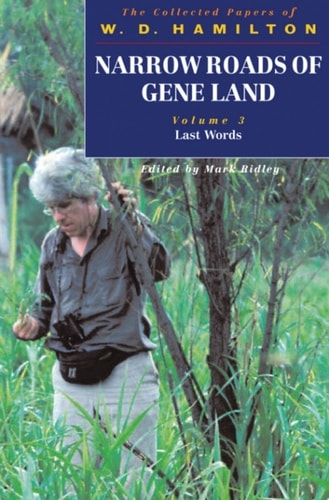
Narrow Roads of Gene Land: The Collected Papers of W. D. Hamilton, Volume 3: Last Words
0
0
As an Amazon Associate and affiliate partner, Menrva Books earns from qualifying purchases. Learn more
Author Description
W. D. Hamilton (1936-2000) has been described by Richard Dawkins as 'a good candidate for the title of most distinguished Darwinian since Darwin'. His work on evolutionary biology continues to influence scientists working across a wide variety of disciplines, including evolution, population genetics, animal behaviour, genetics, anthropology, and ecology. This third and final volume of Narrow Roads of Gene Land contains Hamilton's key papers published between 1990 and 2000, a period in which he covered a great diversity of topics, often in collaboration with other scientists. Many of the papers in this volume continue his work on sex, and particularly its relation to parasitic disease, but other topics covered include the Gaia theory, the colours of autumn leaves, and the still-controversial hypothesis that the AIDS pandemic accidentally originated in a polio vaccination campaign in Africa. Each of the co-authored papers in this volume is preceded by an introduction written by one of Hamilton's co-authors, following the model of the previous two volumes in this series, which brings the reader closer to Hamilton's extraordinary personality and intellect, providing the intellectual and physical contexts within which each piece of research was developed. Also included are a chapter by Jeremy Leighton John on the Hamilton archive - 'Bill's last great work' - complete with irresistible pictures, and Alan Grafen's biographical memoir, which presents an overview of Bill's life and work. Together, this unique collection of papers with their biographical introductions provides a profound portrait of one of the twentieth century's most innovative scientists.
Menrva's Summary
THE THESIS
This volume investigates the final decade of W. D. Hamilton's research, exploring the core question of how evolutionary mechanisms—specifically sex and parasitism—shape biological diversity and complex systems. As one of the most influential Darwinian thinkers of the twentieth century, Hamilton utilized rigorous mathematical modeling and field observation to advance theories in population genetics and ecology. This collection presents his papers from 1990 to 2000, contextualized by biographical introductions from his collaborators to illustrate the development of his scientific framework.
THE SCOPE MAP
What You Will Find
- Research papers on sex, parasitic disease, Gaia theory, and evolutionary ecology
- Analysis of the hypothesis regarding the origins of the AIDS pandemic
- Biographical memoir by Alan Grafen and an overview of the Hamilton archive
- Collaborative introductions providing historical and intellectual context for each paper
Scope Limits
- Does not cover Hamilton's early career or foundational work from the 1960s through the 1980s
- Does not provide a comprehensive textbook overview of evolutionary biology, focusing instead on specific research contributions
THE AUTHORITY PERSPECTIVE
Experts recognize this volume as a critical primary source for understanding the later intellectual trajectory of a foundational figure in evolutionary biology. Readers frequently note the academic density of the prose, which is best suited for those with a background in genetics or evolutionary theory.
Page Count:
494
Publication Date:
2006-01-01
Publisher:
OUP Oxford
ISBN-10:
0191568635
ISBN-13:
9780191568633
Biography
Science
Genetics
Evolutionary Biology
Anthropology
Ecology
Community Tags
Similar Books