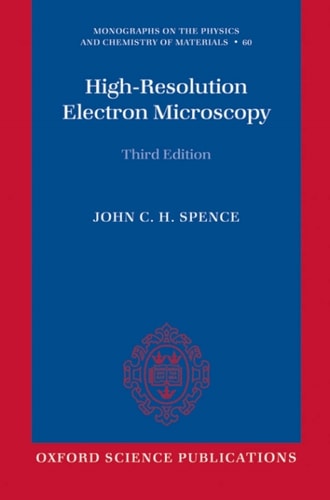
High-Resolution Electron Microscopy
0
0
As an Amazon Associate and affiliate partner, Menrva Books earns from qualifying purchases. Learn more
Author Description
The discovery of the Nanotube in 1991 by electron microscopy has ushered in the era of Nanoscience. The atomic-resolution electron microscope has been a crucial tool in this effort. This book gives the basic theoretical background needed to understand how electron microscopes allow us to see atoms, together with highly practical advice for electron microscope operators. The book covers the usefulness of seeing atoms in the semiconductor industry, in materials science (where scientists strive to make new lighter,stronger, cheaper materials), and condensed matter physics (for example in the study of the new superconductors). Biologists have recently used the atomic-resolution electron microscope to obtain three-dimensional images of the Ribosome, work which is covered in this book. The books also shows how the ability to see atomic arrangements has helped us understand the properties of matter. This new third edition of the standard text retains the early section of the fundamentals of electron optics, linear imaging theory with partial coherence and multiple-scattering theory. Also preserved are updated earlier sections on practical methods, with detailed step-by-step accounts of the procedures needed to obtain the highest quality images of the arrangement of atoms in thin crystals using a modern electron microscope. The sections on applications of atomic resolution transmission electron microscopy (HREM) have been extensively updated, including descriptions of HREM in the semiconductor industry, superconductor research, solid state chemistry and nanoscience, as well as metallurgy, mineralogy, condensed matter physics, materials science and biology. Entirely new sections have been added on electron holography, aberration correctors, field-emission guns, imaging filters, HREM in biology an don organic crystals,super-resolution methods, Ptychography, CCD cameras and Image plates. New chapters are devoted entirely to scanning transmission electron microscopy and Z-contr
Menrva's Summary
THE THESIS
This text investigates the theoretical foundations and practical methodologies required to achieve atomic-resolution imaging using transmission electron microscopy. John C. H. Spence, a prominent researcher in the field, provides a comprehensive framework that bridges the gap between electron optics theory and the operational requirements of modern microscopy. The book synthesizes complex physics with applied techniques to explain how atomic-scale visualization informs advancements in nanoscience, semiconductor manufacturing, and structural biology.
THE SCOPE MAP
What You Will Find
- Theoretical foundations of electron optics, linear imaging theory, and multiple-scattering theory.
- Practical, step-by-step procedures for obtaining high-quality images of atomic arrangements in thin crystals.
- Updated applications in semiconductor research, superconductor analysis, solid-state chemistry, and biological imaging.
- Technical discussions on aberration correctors, electron holography, scanning transmission electron microscopy, and digital imaging sensors.
Scope Limits
- The text assumes a foundational understanding of physics and materials science, excluding introductory-level material for non-specialists.
- It focuses primarily on transmission electron microscopy (TEM) and scanning transmission electron microscopy (STEM) rather than broader, non-electron-based imaging techniques.
THE AUTHORITY PERSPECTIVE
Experts and researchers widely recognize this monograph as a foundational reference for both students and practicing microscopists. Readers frequently note the high level of technical density, which serves as a rigorous guide for those seeking to master the complexities of atomic-resolution imaging.
Page Count:
428
Publication Date:
2008-01-01
Publisher:
OUP Oxford
ISBN-10:
0191564613
ISBN-13:
9780191564611
Science
Physics
Chemistry
Microscopy
Academic
Earth Sciences
Nanotechnology
Community Tags
Other Editions(4)

Similar Books











Reader Comments
Share Your Thoughts
No comments yet. Be the first to share your thoughts!