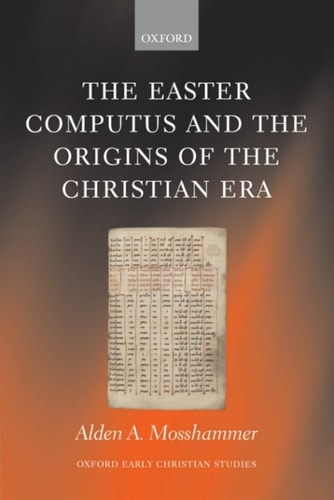
The Easter Computus and the Origins of the Christian Era
0
0
As an Amazon Associate and affiliate partner, Menrva Books earns from qualifying purchases. Learn more
Author Description
The system of numbering the years AD (Anni Domini, Years of the Lord) originated with Dionysius Exiguus. Dionysius drafted a 95-year table of dates for Easter beginning with the year 532 AD. Why Dionysius chose the year that he did to number as '1' has been a source of controversy and speculation for almost 1500 years. According to the Gospel of Luke (3.1; 3.23), Jesus was baptized in the 15th year of the emperor Tiberius and was about 30 years old at the time. The 15th year of Tiberius was AD 29. If Jesus was 30 years old in AD 29, then he was born in the year that we call 2 BC. Most ancient authorities dated the Nativity accordingly. Alden Mosshammer provides the first comprehensive study of early Christian methods for calculating the date of Easter to have appeared in English in more than one hundred years. He offers an entirely new history of those methods, both Latin and Greek, from the earliest such calculations in the late second century until the emergence of the Byzantine era in the seventh century. From this history, Mosshammer draws the fresh hypothesis that Dionysius did not calculate or otherwise invent a new date for the birth of Jesus, instead adopting a date that was already well established in the Greek church. Mosshammer offers compelling new conclusions on the origins of the Christian era drawing upon evidence found in the fragments of Julius Africanus, of Panodorus of Alexandria, and in the traditions of the Armenian church.
Menrva's Summary
THE THESIS
This work investigates the historical and mathematical origins of the Anni Domini dating system, specifically questioning why Dionysius Exiguus selected the year 532 AD as the starting point for his Easter table. Alden A. Mosshammer, a scholar of early Christian history, utilizes a rigorous examination of primary source fragments from figures such as Julius Africanus and Panodorus of Alexandria. He argues that the Christian era was not an invention of Dionysius, but rather the adoption of a pre-existing chronological tradition established within the Greek church. By analyzing the intersection of Easter calculation methods and the dating of the Nativity, the author reconstructs the evolution of early Christian timekeeping.
THE SCOPE MAP
What You Will Find
- A comprehensive history of Latin and Greek Easter calculation methods from the second to the seventh century.
- Analysis of the chronological discrepancies between the Gospel of Luke and ancient Nativity dating traditions.
- Examination of the influence of the Armenian church and Byzantine era developments on Christian chronology.
Scope Limits
- The study focuses primarily on the technical and historical development of the Easter computus rather than the theological implications of the dating system.
- It does not provide a general history of the early Christian church outside of its chronological and calendrical practices.
THE AUTHORITY PERSPECTIVE
Scholars recognize this text as a significant contribution to the field, noting its density and the depth of its primary source analysis. It is frequently cited as the definitive modern English-language resource for understanding the technical origins of the Christian calendar.
Page Count:
474
Publication Date:
2008-01-01
Publisher:
Oxford University Press
ISBN-10:
019156236X
ISBN-13:
9780191562365
History
Religion
Chronology
Easter
Christianity
Academic
Theology
Church History