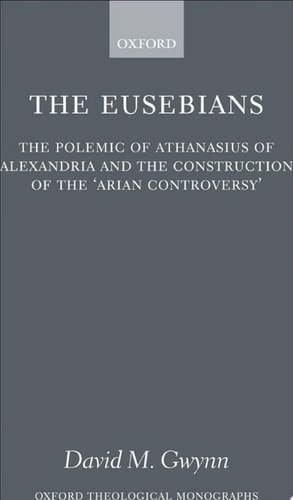
The Eusebians: The Polemic of Athanasius of Alexandria and the Construction of the Arian Controversy
0
0
As an Amazon Associate and affiliate partner, Menrva Books earns from qualifying purchases. Learn more
Author Description
A historical and theological re-evaluation of the polemical writings of Athanasius of Alexandria (bishop 328-73), who would become known to later Christian generations as a saint and a champion of orthodoxy, and as the defender of the original Nicene Creed of 325 against the `Arian heresy'. For much of his own lifetime, however, Athanasius was an extremely controversial figure, and his writings, although highly influential on modern interpretations of the fourth-century Church and the so-called `Arian Controversy', display bias and distortion. David M. Gwynn examines Athanasius' polemic in detail, and in particular his construction of those he condemns as `Arian' as a single `heretical party', 'the Eusebians'. Gwynn argues that Athanasius' image of the Church polarized between his own `orthodoxy' and the `Arianism' of the `Eusebians' is a polemical construct, which has seriously impaired our knowledge of the development of Christianity in the crucial period in which the Later Roman Empire became ever increasingly a Christian empire.
Menrva's Summary
THE THESIS
This work investigates the extent to which Athanasius of Alexandria constructed the concept of an 'Arian' heresy to serve his own polemical objectives. David M. Gwynn, a scholar of late antiquity, utilizes a critical analysis of Athanasian texts to challenge the traditional historiography of the fourth-century Church. He argues that the binary opposition between 'orthodoxy' and 'Arianism' was a deliberate rhetorical strategy rather than an accurate reflection of the theological landscape of the era.
THE SCOPE MAP
What You Will Find
- A detailed examination of the polemical writings of Athanasius of Alexandria.
- An analysis of the historical figure of the 'Eusebians' as a constructed group.
- A re-evaluation of the development of Christianity within the Later Roman Empire.
Scope Limits
- The study focuses primarily on Athanasius's perspective and rhetoric rather than a comprehensive history of the entire Arian movement.
- It does not provide a general biography of Athanasius outside the context of his polemical output.
THE AUTHORITY PERSPECTIVE
Scholars recognize this text as a significant contribution to the field of patristics and the study of early Christian history. Readers frequently note the academic density of the prose, which is intended for an audience familiar with theological and historical discourse.
Page Count:
316
Publication Date:
2006-01-01
Publisher:
OUP Oxford
ISBN-10:
0191607142
ISBN-13:
9780191607141
History
Religion
Patristics
Christianity
Church History
Theology
Academic
Community Tags
Other Editions(3)
Similar Books