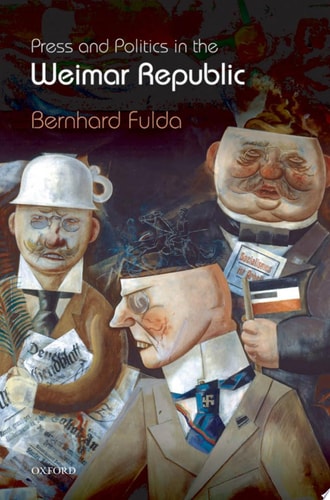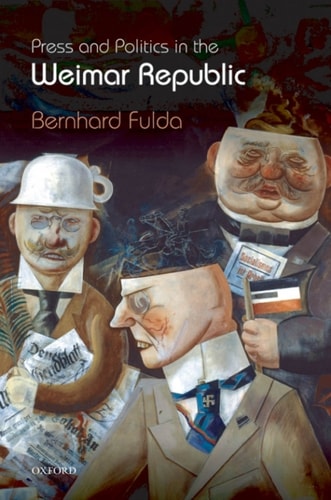
Press and Politics in the Weimar Republic
0
0
As an Amazon Associate and affiliate partner, Menrva Books earns from qualifying purchases. Learn more
Author Description
Press and Politics offers a new interpretation of the fate of Germany's first democracy and the advent of Hitler's Third Reich. It is the first study to explore the role of the press in the politics of the Weimar Republic, and to ask how influential it really was in undermining democratic values. Anyone who seeks to understand the relationship between the press and politics in Germany at this time has to confront a central problem. Newspapers certainly told their readers how to vote, especially at election time. It was widely accepted that the press wielded immense political power. And yet power ultimately fell to Adolf Hitler, a radical politician whose party press had been strikingly unsuccessful. Press and Politics unravels this apparent paradox by focusing on Berlin, the political centre of the Weimar Republic and the capital of the German press. The book examines the complex relationship between media presentation, popular reception, and political attitudes in this period. What was the relationship between newspaper circulation and electoral behaviour? Which papers did well, and why? What was the nature of political coverage in the press? Who was most influenced by it? Bernhard Fulda addresses all these questions and more, looking at the nature and impact of newspaper reporting on German politics, politicians, and voters. He shows how the press personalized politics, how politicians were turned into celebrities or hate figures, and how - through deliberate distortions - individual newspapers succeeded in building up a plausible, partisan counter-reality.
Menrva's Summary
THE THESIS
This study investigates the paradox of how the German press, widely considered a potent political force, failed to prevent the rise of Adolf Hitler despite its pervasive influence on public discourse. Bernhard Fulda, a historian specializing in modern German history, utilizes a rigorous analytical framework to examine the intersection of media, electoral behavior, and political culture in Berlin. By analyzing circulation data, editorial strategies, and reader reception, the author argues that the press functioned as a mechanism for constructing partisan realities that ultimately destabilized democratic norms.
THE SCOPE MAP
What You Will Find
- Analysis of the relationship between newspaper circulation and electoral outcomes in Berlin.
- Examination of how political figures were transformed into media celebrities or targets of vilification.
- Investigation into the mechanics of partisan counter-realities created by specific media outlets.
Scope Limits
- The study focuses primarily on Berlin as the political and media capital, rather than providing a comprehensive regional analysis of all German states.
THE AUTHORITY PERSPECTIVE
Scholars and historians recognize this work as a foundational text for understanding the media landscape of the Weimar Republic. Readers frequently note the academic density of the prose and the meticulous archival research that supports the author's conclusions.
Page Count:
324
Publication Date:
2009-01-01
Publisher:
Oxford University Press
ISBN-10:
0191563269
ISBN-13:
9780191563263
History
European History
Media Studies
German history
Journalism