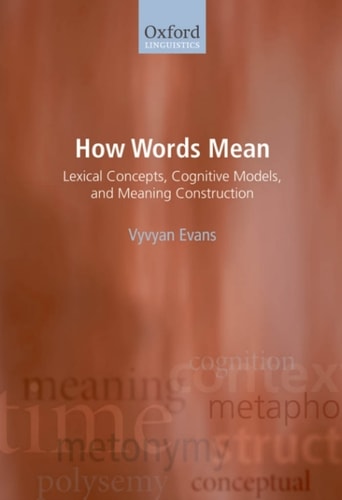
How Words Mean: Lexical Concepts, Cognitive Models, and Meaning Construction
0
0
As an Amazon Associate and affiliate partner, Menrva Books earns from qualifying purchases. Learn more
Author Description
How Words Mean introduces a new approach to the role of words and other linguistic units in the construction of meaning. It does so by addressing the interaction between non-linguistic concepts and the meanings encoded in language. It develops an account of how words are understood when we produce and hear language in situated contexts of use. It proposes two theoretical constructs, the lexical concept and the cognitive model. These are central to the accounts of lexical representation and meaning construction developed, giving rise to the Theory of Lexical Concepts and Cognitive Models (or LCCM Theory). Vyvyan Evans integrates and advances recent developments in cognitive science, particularly in cognitive linguistics and cognitive psychology. He builds a framework for the understanding and analysis of meaning that is at once descriptively adequate and psychologically plausible. In so doing he also addresses current issues in lexical semantics and semantic compositionality, polysemy, figurative language, and the semantics of time and space, and writes in a way that will be accessible to students of linguistics and cognitive science at advanced undergraduate level and above.
Menrva's Summary
THE THESIS
This work investigates how linguistic units interact with non-linguistic concepts to construct meaning within situated contexts of use. Vyvyan Evans, a scholar in cognitive linguistics, utilizes advancements in cognitive science and psychology to propose the Theory of Lexical Concepts and Cognitive Models (LCCM Theory). The text argues that meaning is not static but is instead constructed through the interaction of lexical concepts and cognitive models, providing a framework that is both descriptively adequate and psychologically plausible.
THE SCOPE MAP
What You Will Find
- The Theory of Lexical Concepts and Cognitive Models (LCCM Theory)
- Analysis of lexical representation and semantic compositionality
- Examination of polysemy and figurative language
- Exploration of the semantics of time and space
Scope Limits
- The text focuses primarily on cognitive linguistics and may not cover traditional formalist or generative semantic approaches in depth.
- It is intended for an academic audience and does not serve as an introductory guide for lay readers.
THE AUTHORITY PERSPECTIVE
Experts recognize this text as a significant contribution to cognitive semantics and a foundational resource for understanding LCCM Theory. Readers frequently note the academic density of the prose, which is tailored for advanced undergraduate students and professional linguists.
Page Count:
320
Publication Date:
2009-01-01
Publisher:
Oxford University Press
ISBN-10:
0191571156
ISBN-13:
9780191571152
Cognitive Psychology
English
English & College Success
Language Theory
Semantics
Linguistics
Lexicology
Community Tags
Similar Books