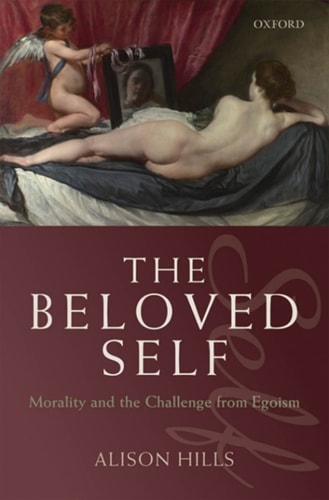
The Beloved Self: Morality and the Challenge from Egoism
0
0
As an Amazon Associate and affiliate partner, Menrva Books earns from qualifying purchases. Learn more
Author Description
The Beloved Self is about the holy grail of moral philosophy, an argument against egoism that proves that we all have reasons to be moral. Part One introduces three different versions of egoism. Part Two looks at attempts to prove that egoism is false, and shows that even the more modest arguments that do not try to answer the egoist in her own terms seem to fail. But in part Three, Hills defends morality and develops a new problem for egoism, an epistemological problem. She shows that it is not epistemically rational to believe the most plausible versions of egoism. The first part of the book will be most relevant to those interested in moral theory, as it contains detailed discussions of recent interpretations of virtue ethics and especially of Kant's moral theory. The second and third part of the book turn to epistemology, particularly moral epistemology, and include an account of the relationship between knowledge and action, a new theory of moral understanding, and a discussion of the epistemically rational response to various kinds of disagreement. Hills also defends a new account of virtue and of morally worthy action.
Menrva's Summary
THE THESIS
This book investigates the core question of whether moral philosophy can provide a definitive argument against egoism that proves individuals have rational reasons to act morally. Alison Hills, a philosopher specializing in ethics and epistemology, examines the logical foundations of egoism and the failure of traditional attempts to refute it. By shifting the focus from purely moral arguments to epistemological ones, she constructs a framework that challenges the rationality of holding egoistic beliefs. Her analysis integrates moral theory with contemporary epistemological concerns to propose a new perspective on moral understanding and virtuous action.
THE SCOPE MAP
What You Will Find
- A classification of three distinct versions of egoism.
- A critical evaluation of existing arguments against egoism.
- An epistemological critique of the rationality of egoistic belief systems.
- A new theory regarding the relationship between moral knowledge and action.
- An account of moral understanding and its role in virtuous behavior.
Scope Limits
- The text does not provide a comprehensive history of all ethical schools of thought.
- It does not offer a practical self-help guide for daily moral decision-making.
THE AUTHORITY PERSPECTIVE
Experts in moral philosophy recognize this work as a rigorous contribution to the debate between egoism and morality. Readers frequently note the academic density of the prose, which requires a strong background in ethical theory and epistemology to fully grasp the author's arguments.
Page Count:
288
Publication Date:
2010-01-01
Publisher:
Oxford University Press
ISBN-10:
0191576093
ISBN-13:
9780191576096
Philosophy
Egoism
Ethics
Moral Philosophy
Epistemology
Community Tags
Similar Books