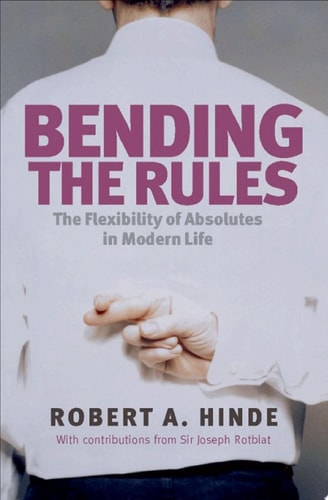
Bending the Rules: The Flexibility of Absolutes in Modern Life
0
0
As an Amazon Associate and affiliate partner, Menrva Books earns from qualifying purchases. Learn more
Author Description
Everywhere people share certain moral principles - it is bad to steal, to kill, to lie. We see our morality as absolute, yet we live by rules that differ with the context: it is ok to kill the enemy in war; for a businessman to do the best for himself; for a lawyer to argue professionally for a position he would personally reject. We are constantly 'bending the rules', while considering our moral principles as absolute. Robert Hinde, the eminent Cambridge biologist and psychologist, presents a new approach to morality based on combining an evolutionary approach with observations on how people actually behave to show that morality is more subtle than it appears. The complexity of modern societies requires the rules to be somewhat flexible according to the context - personal relationships, science, law, business, politics and war. Some bending of rules is necessary for social cohesion; but too much is destructive. Hinde argues from a humanistic standpoint for a deeper appreciation of the nature of morality, so that we may avoid global catastrophe, and strive for a more ethical, just, and peaceful world.
Menrva's Summary
THE THESIS
This book investigates the inherent contradiction between our belief in absolute moral principles and the necessity of context-dependent rule-bending in modern society. Robert A. Hinde, a distinguished biologist and psychologist from Cambridge, synthesizes evolutionary theory with behavioral observation to explain how human morality functions in practice. He argues that while rigid adherence to rules is often impossible, the flexibility required for social cohesion must be balanced against the risks of moral erosion to prevent global catastrophe.
THE SCOPE MAP
What You Will Find
- Analysis of moral flexibility across diverse domains including law, business, politics, and personal relationships.
- An evolutionary framework for understanding the development of human social norms.
- A humanistic argument for ethical awareness in a complex, globalized world.
Scope Limits
- The text does not provide a prescriptive manual for specific moral dilemmas.
- It does not focus on theological or purely religious interpretations of morality.
THE AUTHORITY PERSPECTIVE
Experts recognize this work as a significant interdisciplinary contribution that bridges biological evolution and social ethics. Readers frequently note the academic density of the prose, which requires careful attention to follow Hinde's nuanced arguments regarding social cohesion.
Page Count:
288
Publication Date:
2008-01-01
Publisher:
OUP Oxford
ISBN-10:
0191578738
ISBN-13:
9780191578731
Non-Fiction
Philosophy
Evolutionary Psychology
Evolution
Sociology
Humanism
Ethics
Community Tags
Similar Books