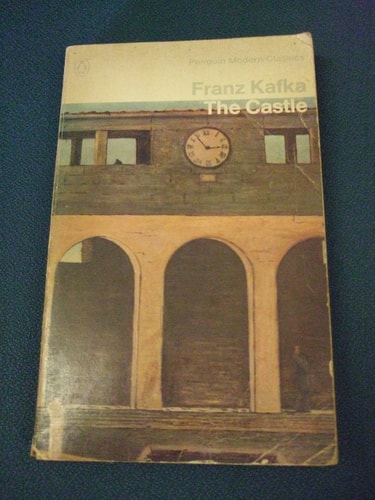
The Castle
0
0
As an Amazon Associate and affiliate partner, Menrva Books earns from qualifying purchases. Learn more
Author Description
'K. kept feeling that he had lost himself, or was further away in a strange land than anyone had ever been before' A remote village covered almost permanently in snow and dominated by a castle and its staff of dictatorial, sexually predatory bureaucrats - this is the setting for Kafka's story about a man seeking both acceptance in the village and access to the castle. Kafka breaks new ground in evoking a dense village community fraught with tensions, and recounting an often poignant, occasionally farcical love-affair. He also explores the relation between the individual and power, and asks why the villagers so readily submit to an authority which may exist only in their collective imagination. Published only after Kafka's death, The Castle appeared in the same decade as modernist masterpieces by Eliot, Joyce, Woolf, Mann and Proust, and is among the central works of modern literature. This translation follows the text established by critical scholarship, and manuscript variants are mentioned in the notes. The introduction provides guidance to the text without reducing the reader's own freedom to make sense of this fascinatingly enigmatic novel. ABOUT THE SERIES: For over 100 years Oxford World's Classics has made available the widest range of literature from around the globe. Each affordable volume reflects Oxford's commitment to scholarship, providing the most accurate text plus a wealth of other valuable features, including expert introductions by leading authorities, helpful notes to clarify the text, up-to-date bibliographies for further study, and much more.
Menrva's Summary
THE PULSE
A land surveyor named K. arrives in a snow-bound village, only to find himself trapped in an endless, futile struggle to gain recognition and entry into the mysterious Castle that governs the region. K. seeks to establish his professional legitimacy and secure a place within the local social hierarchy, but he is constantly thwarted by the opaque, shifting, and contradictory rules enforced by the Castle's bureaucratic apparatus. The narrative follows his increasingly desperate attempts to navigate these administrative labyrinths, which function as both a physical obstacle and a psychological prison. Written in a detached, third-person perspective, the story emphasizes the protagonist's isolation and the absurdity of his environment.
INSIDE THE PAGES
- Surreal, dream-like atmosphere
- Bureaucratic absurdity and administrative circularity
- Themes of alienation and individual powerlessness
- Unreliable and shifting social hierarchies
- Detailed, claustrophobic village setting
- Exploration of existential anxiety
- Fragmented and unfinished narrative structure
- Focus on the tension between the individual and institutional authority
THE COLLECTIVE ECHO
Discussion often centers on the novel's status as a primary example of existentialist literature and its critique of dehumanizing power structures. Readers frequently highlight the frustrating, repetitive nature of K.'s interactions, which mirrors the very bureaucracy he attempts to penetrate. Critics often note the effectiveness of the atmosphere, where the constant presence of snow and the looming, inaccessible Castle create a sense of pervasive dread. The work remains a subject of intense analysis regarding its unfinished state and the various interpretations of its allegorical depth. Many readers find the lack of resolution to be a deliberate stylistic choice that reinforces the themes of futility and uncertainty.
Page Count:
318
Publication Date:
2009-01-01
Publisher:
OUP Oxford
ISBN-10:
019157984X
ISBN-13:
9780191579844
classic
Allegorical
English & College Success
Surrealist
English
Modernist
Philosophical
Existential