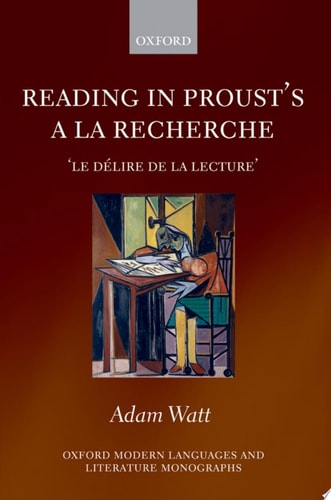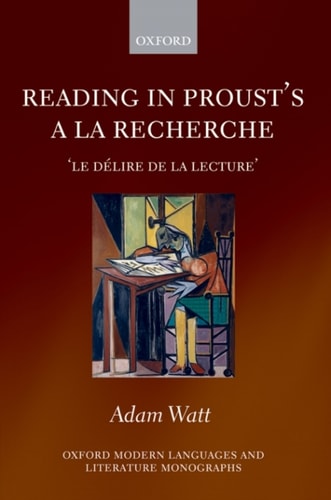
Reading in Proust's A la recherche: 'le délire de la lecture'
0
0
As an Amazon Associate and affiliate partner, Menrva Books earns from qualifying purchases. Learn more
Author Description
Through close textual analysis of the scenes of reading in Proust's A la recherche du temps perdu, Adam Watt offers an invigorating new study of the novel and previously unacknowledged paths through it. After considering key childhood 'Primal Scenes' which mark the act of reading as revelatory and potentially traumatic, the book then identifies and examines the interwoven strands of the novel's narrative of reading: showing that scenes where the narrator reads and where others provide 'lessons in reading' are intricately connected within the narrator's ever unfolding considerations of intelligence, sense experience, knowledge, and desire. These acts of reading, often bewildering the narrator with their mix of illuminations, wrong turns and over-determinations, lead us to interrogate our own understanding of the act we accomplish as we read A la recherche. This book emphasizes the complexities and contradictions with which reading (always inescapably an engagement of both mind and body) is riven, and which connect it repeatedly to the experience of involuntary memory. Reading is shown to be frequently fraught with heady instability-'délire'-of a highly revealing sort, from which narrator and readers alike have much to learn. The book's final chapter shows how the narrator's critical energies, turned contemplatively inwards in the Guermantes' library, are subsequently turned outwards for a final interpretive effort-the reading of his now aged acquaintances at the 'Bal de têtes'-in a shift that provides the narrator not only the confidence to begin his work of art, but also the humility to face, undeterred, the approach of death.
Menrva's Summary
THE THESIS
*This study investigates the central role of reading as both a thematic preoccupation and a structural mechanism within Marcel Proust's A la recherche du temps perdu.* Adam Watt, a professor of French literature, utilizes close textual analysis to argue that the act of reading is not merely a passive activity for the narrator but a complex, often destabilizing experience that informs the narrator's development of intelligence, desire, and involuntary memory. By mapping these reading scenes, Watt demonstrates how the narrator's internal intellectual evolution mirrors the reader's own engagement with the text.
THE SCOPE MAP
What You Will Find
- Analysis of childhood 'Primal Scenes' of reading in Proust's work.
- Examination of 'lessons in reading' provided by secondary characters.
- Exploration of the connection between reading, involuntary memory, and sensory experience.
- Analysis of the narrator's final interpretive efforts at the 'Bal de têtes'.
Scope Limits
- The study focuses exclusively on the act of reading within the text rather than a comprehensive biography of Proust.
- It does not provide a general summary of the novel's plot, assuming prior familiarity with the source material.
THE AUTHORITY PERSPECTIVE
Scholars and students of French literature frequently cite this work for its rigorous approach to Proustian aesthetics and its focus on the meta-textual elements of the novel. Readers often note the academic density of the prose, which is intended for those already deeply familiar with the complexities of the original text.
Page Count:
240
Publication Date:
2009-01-01
Publisher:
Oxford University Press
ISBN-10:
0191570265
ISBN-13:
9780191570261
English & College Success
Proustian Studies
French literature
English
Literary Criticism
Academic
Literary theory