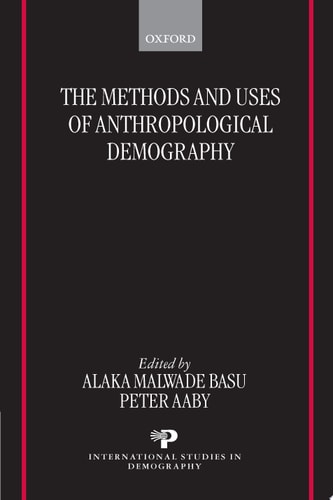
The Methods and Uses of Anthropological Demography
0
0
As an Amazon Associate and affiliate partner, Menrva Books earns from qualifying purchases. Learn more
Author Description
This volume takes stock of the current status of the comparatively new discipline of `anthropological demography', and discusses its major methods, its main strengths, and its chief limitations. It includes contributions from both mainstream demographers and foremost anthropologists, all stressing the necessity of a shared agenda for each discipline to progress successfully and avoid marginalization. While the unique research and personal satisfaction afforded by `participant observation' is described, the book also highlights the potential contribution to the understanding of demographic events of much more than the field methods of traditional anthropology. In particular, it stresses the insights possible from qualitative focus group interviews, from longitudinal studies and from a greater interest in `armchair' anthropology, in which demographers complement their quantitative findings with qualitative information and understanding gleaned from a careful reading of the anthropological literature, in the form of both ethnographies and anthropological theories. In addition, it stresses the larger world of the ideal anthropological demographer: a world that includes the cultural context of course, but also takes into account the historical and political forces that condition so much individual behaviour. But the book is also a critical venture. It includes therefore considerable discussion of the common limits of the purely anthropological approach for understanding demographic events and processes, especially from a larger policy perspective, at the same time as it emphasizes the crucial role of the anthropological approach to designing policy that is potentially effective as well as socially and culturally sensitive. It reiterates the often complementary role of anthropological demography and also discusses some specific questions in demographic research which it does not as yet seem to have the capacity to illuminate. The book is aimed primarily at demographers.
Menrva's Summary
THE THESIS
This volume investigates the integration of anthropological methods into demographic research to create a more comprehensive understanding of human population dynamics. The authors, Alaka Malwade Basu and Peter Aaby, assemble contributions from both demographers and anthropologists to argue that the two disciplines must share an agenda to remain relevant and effective. The text posits that quantitative demographic data is significantly enhanced when contextualized by the qualitative insights and cultural understanding inherent in anthropological practice.
THE SCOPE MAP
What You Will Find
- Methodologies including participant observation, qualitative focus group interviews, and longitudinal studies
- Analysis of the role of historical and political forces in shaping individual behavior
- Frameworks for designing socially and culturally sensitive public policy
- Discussion on the limitations of purely anthropological approaches in large-scale demographic modeling
Scope Limits
- Does not provide an exhaustive guide to all statistical demographic software
- Does not cover every sub-discipline of biological anthropology
- Does not address demographic questions that currently remain outside the scope of anthropological inquiry
THE AUTHORITY PERSPECTIVE
Experts recognize this work as a foundational text for scholars seeking to bridge the gap between quantitative population studies and qualitative social analysis. Readers frequently note the academic density of the prose, which is intended for researchers and graduate students in the social sciences.
Page Count:
342
Publication Date:
1998-01-01
Publisher:
Clarendon Press
ISBN-10:
0191584460
ISBN-13:
9780191584466
Social Science
Anthropology
Sociology
Demography
Community Tags
Other Editions(2)
Similar Books






Reader Comments
Share Your Thoughts
No comments yet. Be the first to share your thoughts!