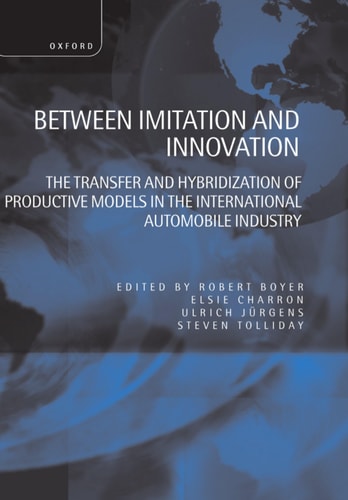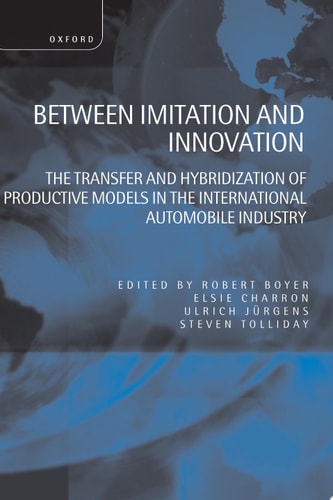
Between Imitation and Innovation
0
0
As an Amazon Associate and affiliate partner, Menrva Books earns from qualifying purchases. Learn more
Author Description
Recent Years Have Seen Intense Debates Among Management And Academics On The Rise Of `lean Production' And `japanization'. Some Authors Have Stressed The `universal' Impact Of New Forms Of Work Organization And `best Practice' While Others Have Questioned The Limits Of Convergence, Stressed The Weight Of National Contexts Or `societal Effects', Or Highlighted The Evolutionary Effects Of Unpredictability In The External Environment. The International Automobile Industry Has Been A Focus For Much Of This Debate And This Book, Written By A Team Of Leading International Researchers In The Field, Uses This Industry To Examine In Detail The Actual Practice Of The Transfer And Adaptation Of Productive Models And The Trajectories Of Innovation, Compromise, And Failure That Can Result. Case Studies Cover In Detail The Japanese Transplant Experience In North America, And The Global Experience Of Hybrid Production Systems In Europe, Latin America, And Asia. The Book Contributes To Theoretical Discussions About The Transfer, Adaptation, Or Convergence Of Productive Models. In Particular, The Authors Argue That Direct Transplantation Or Imitation Of These Models Is Rarely Feasible Or Even Desirable. Systems Cannot Be Transferred Without Being Significantly Reshaped. Instead, The Book Focuses On The Process Of `hybridization', The Complex Interaction Of Productive Models With National And Societal Effects. Hybridization, It Is Argued, Is Inevitable. But This Should Be Seen Not Simply As A Process Of Compromise And Retreat But Also As An Important Dynamic Of Innovation And Learning. This Book Is From The French-based International Research Network Gerpisa (groupe D'étude De Récherche Permanent Sur L'industrie Et Les Salaries De L'automobile). See Related Titles Below.
Menrva's Summary
THE THESIS
This book investigates whether the global adoption of lean production models leads to universal convergence or necessitates local adaptation. The authors, a team of researchers from the international network GERPISA, analyze the automotive industry to challenge the notion that management practices can be directly transplanted across borders. They argue that the interaction between imported production systems and existing national or societal contexts inevitably results in a process of hybridization rather than simple imitation.
THE SCOPE MAP
What You Will Find
- Comparative analysis of Japanese transplant operations in North America.
- Examination of hybrid production systems across Europe, Latin America, and Asia.
- Theoretical framework regarding the transfer and adaptation of productive models.
Scope Limits
- The analysis is primarily restricted to the automotive manufacturing sector.
- The text does not provide a general manual for implementing lean production in non-automotive industries.
THE AUTHORITY PERSPECTIVE
Experts recognize this work as a significant contribution to the study of industrial organization and the limitations of global management standardization. Readers frequently note the academic density of the prose and the rigorous reliance on international case studies to support the authors' arguments.
Page Count:
418
Publication Date:
1998-01-01
Publisher:
Oup Oxford
ISBN-10:
0191583944
ISBN-13:
9780191583940
Business
Economics
Management
Globalization
Automotive Industry
Community Tags
Similar Books