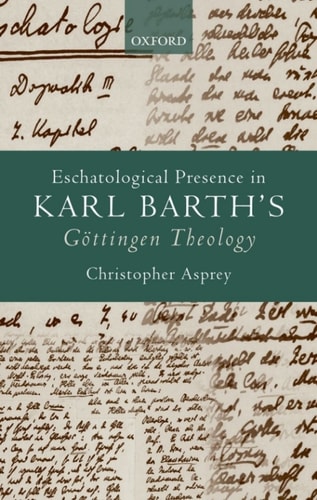
Eschatological Presence in Karl Barth's Gottingen Theology
0
0
As an Amazon Associate and affiliate partner, Menrva Books earns from qualifying purchases. Learn more
Author Description
The posthumous publication of previously unavailable academic lectures by Karl Barth allows unprecedented access to the crucial formative years between the production of his two major masterpieces, the Commentary on Romans and the Church Dogmatics. Barth was professor at the University of Göttingen (1921-1926). It was here that he was to formulate many of the ideas that would later be developed or altered in the Church Dogmatics. Providing insightful comparisons and contrast with some of Barth's major contemporaries, Christopher Asprey draws widely on the lecture courses, as well as on other better known texts from the period, to give a comprehensive account of Barth's theology in these years. Unterricht in der christlichen Religion (Göttingen Dogmatics), the only full dogmatics cycle Barth completed during his lifetime, provides a key focus for Asprey's study. A picture emerges of Barth's concerns during this period that is different from many other established accounts: rather than being 'occasionalist' or dualist, Barth's theology in the 1920s was characterised by an orientation towards the eschatological encounter between God and humankind. Barth's intention in the Göttingen Dogmatics was to introduce his students to their responsibility before the Word of God, all other theological topics then flowing towards or from the 'dialogical' moment of encounter between this Word and human beings. This reading is borne out by in-depth analyses of some of the major themes in the dogmatics: revelation, incarnation, resurrection, pneumatology, moral and sacramental theology. While Barth's focus on the eschatological presence of God explains the freshness and immediacy of his writing in the 1920s, it is also shown at a number of points how this perspective generates various dilemmas in his theology, which remain unresolved during this period.
Menrva's Summary
THE THESIS
This work investigates the central role of eschatological presence in Karl Barth's theology during his formative tenure at the University of Göttingen. Christopher Asprey, a scholar of systematic theology, utilizes previously unavailable lecture materials and the 'Göttingen Dogmatics' to challenge prevailing interpretations of Barth's early work. He argues that Barth’s theology during the 1920s was not defined by occasionalism or dualism, but by a consistent focus on the dialogical encounter between the Word of God and humanity.
THE SCOPE MAP
What You Will Find
- Analysis of the 'Unterricht in der christlichen Religion' (Göttingen Dogmatics).
- Comparative study of Barth’s contemporaries and their influence on his development.
- Examination of core theological themes including revelation, incarnation, resurrection, and pneumatology.
Scope Limits
- The analysis is strictly confined to the period of 1921-1926 at the University of Göttingen.
- The text does not provide a general biography of Barth outside of his academic output during these specific years.
THE AUTHORITY PERSPECTIVE
Scholars recognize this text as a significant contribution to Barthian studies, particularly for its use of primary source lecture materials that were previously inaccessible. Readers frequently note the academic density of the prose, which is intended for advanced students of theology and professional researchers.
Page Count:
256
Publication Date:
2010-01-01
Publisher:
Oxford University Press
ISBN-10:
0191591556
ISBN-13:
9780191591556
Religion
Eschatology
Academic
Karl Barth
Philosophy of
Theology
Community Tags
Similar Books